May
15

- by Dhruv Ainsley
- 0 Comments
Coding Path Finder: Find Your First Programming Language
Answer 3 simple questions about your goals to get a personalized recommendation for your first coding journey.
What kind of projects excite you most?
How do you prefer to see results?
What's your primary motivation?
Your Recommended Path
Standing at the start of a coding journey feels a bit like standing in front of a massive library. You want to read something useful, but there are thousands of books with titles you don’t recognize. Python, JavaScript, C++, Ruby-the list goes on. The biggest mistake new learners make is picking a language based on hype rather than their actual goals. If you want to build websites immediately, starting with C++ is going to frustrate you. If you want to analyze data, starting with HTML won’t get you there.
The truth is, there is no single "best" language. There is only the best language for your specific outcome. Your first language should be the one that gets you building something you care about as quickly as possible. That early win keeps you motivated when things get tough. Let’s break down the top contenders and help you pick the right path.
Why Your Goal Matters More Than the Language
Before we look at syntax or speed, we need to talk about intent. Why do you want to learn to code? Are you looking to switch careers into software engineering? Do you want to automate boring tasks at your current job? Or do you just want to build a personal portfolio website?
Your answer dictates your tool. Think of programming languages like instruments in an orchestra. A violin (JavaScript) is perfect for a solo performance on stage (the web), while a cello (Python) provides deep, foundational support for complex structures (data science). You wouldn’t try to play a heavy metal riff on a flute. Similarly, trying to build a mobile app with pure Python is possible but unnecessarily painful compared to using Swift or Kotlin.
- Web Development: You want to create interactive websites and apps accessible via browsers.
- Data Science & AI: You want to analyze datasets, build machine learning models, or work with artificial intelligence.
- Mobile Apps: You want to build applications for iPhones or Android devices.
- Game Development: You want to create video games with high-performance graphics.
- Automation & Scripting: You want to write small programs to handle repetitive computer tasks.
If you can’t decide yet, don’t worry. Most beginners default to Python or JavaScript because they offer the widest range of immediate gratification. We’ll dive into those next.
Python: The Gentle Giant
Python is a high-level, interpreted programming language known for its readability and versatility. It is widely considered the best first language for absolute beginners, and for good reason. Python’s syntax reads almost like plain English. This reduces the cognitive load required to understand what the code is doing, allowing you to focus on logic rather than memorizing semicolons and curly braces.
In 2026, Python remains the dominant force in data science, artificial intelligence, and backend web development. Libraries like Pandas for data manipulation and TensorFlow or PyTorch for machine learning have made it the industry standard. If you are interested in tech trends like AI automation or big data analytics, Python is non-negotiable.
However, Python has a downside for some. It is not typically used for frontend web development (what users see in their browser) or mobile app development. If your dream is to build flashy user interfaces, Python might feel too slow or indirect. But for general-purpose programming and scripting, it is hard to beat.
| Pros | Cons |
|---|---|
| Extremely readable syntax | Slower execution speed compared to compiled languages |
| Huge community and resources | Not ideal for mobile app development |
| Dominant in Data Science and AI | Can hide underlying computer science concepts |
| Versatile for automation scripts | Less common in high-performance gaming |
JavaScript: The Language of the Web
JavaScript is the primary programming language for web browsers, enabling interactive and dynamic content on websites. If you want to see results instantly, JavaScript is your best bet. Unlike Python, which often requires setting up a server or environment to run, JavaScript runs directly in your web browser. You can open a simple text editor, write a few lines of code, save it as an HTML file, and double-click it to see it work. That instant feedback loop is incredibly powerful for motivation.
Learning JavaScript means learning how the web works. It pairs with HTML (structure) and CSS (style) to form the holy trinity of frontend development. In 2026, frameworks like React, Vue, and Angular dominate the job market for frontend roles. Furthermore, with Node.js, you can now use JavaScript for backend server-side programming too, making it a full-stack solution.
The catch? JavaScript can be quirky. It has some historical baggage and type-coercion behaviors that confuse beginners (like `[] + [] = ""`). But once you master it, you unlock the entire world of web development, which is still the largest sector in tech hiring.
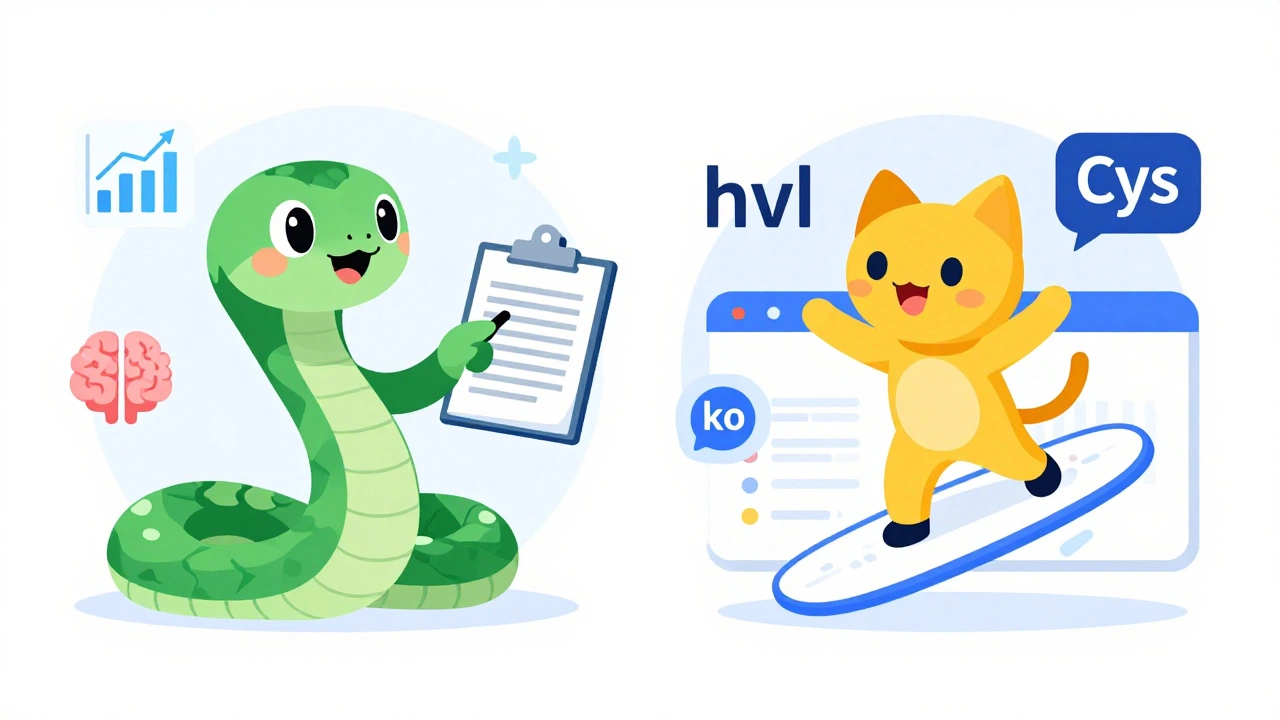
Other Contenders: When to Look Elsewhere
While Python and JavaScript cover about 80% of beginner needs, there are specific cases where other languages shine.
TypeScript
If you choose JavaScript, you will eventually hear about TypeScript. It is essentially JavaScript with strict type checking added on top. While it adds complexity, it catches errors before your code runs. Many professional teams prefer TypeScript for larger projects. As a beginner, stick to vanilla JavaScript first, then transition to TypeScript once you understand the basics.
C# and Unity
If your heart belongs to game development, skip Python and JavaScript. Go straight to C#. It is the primary language for the Unity game engine, which powers a huge portion of indie and AAA games. C# is structured, object-oriented, and teaches you solid programming fundamentals that transfer well to other languages later.
Swift or Kotlin
If you are dead set on building mobile apps, you have two choices. For iPhones and iPads, learn Swift. For Android devices, learn Kotlin. Both are modern, safe, and designed by Apple and Google respectively to replace older, more cumbersome languages (Objective-C and Java). They are excellent first languages if your goal is strictly mobile.
How to Choose: A Decision Framework
Still stuck? Use this simple decision tree to narrow it down.
- Do you want to build visual things that people click on?
- Yes → Start with HTML/CSS and JavaScript.
- No → Go to question 2.
- Are you interested in data, AI, or automating office tasks?
- Yes → Start with Python.
- No → Go to question 3.
- Do you want to make video games?
- Yes → Start with C# and Unity.
- No → Go to question 4.
- Do you want to build mobile apps?
- iPhone only → Swift.
- Android only → Kotlin.
- Both → Consider cross-platform tools like React Native (requires JavaScript knowledge).
If you truly cannot decide, pick Python. It is the safest bet for learning general programming logic without getting bogged down in web-specific quirks or memory management complexities. Once you know one language, learning a second one becomes significantly easier because the core concepts (variables, loops, functions, conditionals) remain the same.

Avoiding Common Beginner Traps
Choosing the language is step one. Keeping momentum is step two. Here is how most people fail, and how you can avoid it.
Tutorial Hell: This is when you watch endless videos but never write code yourself. You feel like you understand, but when you open a blank file, you freeze. Break out of this by building tiny projects after every concept. Want to learn loops? Write a program that prints numbers 1 to 100. Want to learn variables? Write a calculator that adds two numbers.
Comparing Yourself to Experts: Developers with 10 years of experience look like wizards. Remember, they started exactly where you are. Imposter syndrome is normal. Focus on your own progress, not someone else’s GitHub profile.
Switching Languages Too Soon: It takes about 3-6 months to become comfortable with a language. Don’t jump from Python to JavaScript because you heard JavaScript is "more popular." Stick with one until you can build a complete project without looking up every single line of code.
Resources to Get Started in 2026
You don’t need an expensive bootcamp to start. The internet is filled with high-quality, free resources.
- freeCodeCamp: Excellent for interactive, hands-on JavaScript and Python lessons.
- The Odin Project: A rigorous, full-stack curriculum focused on Ruby and JavaScript.
- Codecademy: Good for quick, bite-sized syntax practice.
- MDN Web Docs: The bible for web developers. Always refer here for accurate JavaScript documentation.
- Real Python: High-quality tutorials specifically for Python learners.
Remember, coding is a skill, not just knowledge. You learn by doing, failing, debugging, and trying again. Pick a language, install the necessary tools, and write your first "Hello World" today. The rest of the journey unfolds from there.
Is Python harder than JavaScript?
Generally, Python is considered easier for absolute beginners because its syntax is cleaner and closer to natural English. JavaScript has more quirks related to how browsers interpret code, which can be confusing initially. However, both are manageable if you have a clear goal.
Can I learn multiple languages at once?
It is not recommended. Learning two languages simultaneously can lead to confusion between syntaxes (e.g., forgetting whether to use colons or semicolons). Master the basics of one language first, then adding a second will be much faster and easier.
Do I need a computer science degree to learn these languages?
No. Most professional developers are self-taught or learned through bootcamps and online courses. Employers care more about your ability to solve problems and build working applications than your academic background.
What hardware do I need to start coding?
You just need a standard laptop or desktop computer. A Mac, Windows PC, or Linux machine will all work fine for learning Python or JavaScript. You do not need a high-end gaming PC unless you plan to develop complex 3D games later on.
How long does it take to learn a programming language?
To grasp the basic syntax, you might need a few weeks. To become job-ready, it typically takes 6 to 12 months of consistent practice (several hours a week). Mastery is a lifelong process, but you can build real projects within the first three months.

Dhruv Ainsley
I am an education specialist with a focus on international educational systems, particularly in India. I enjoy exploring how educational practices can be improved to foster better learning environments. Writing about such topics allows me to share insights and encourage meaningful discussions. My work seeks to inspire educational reforms that prioritize inclusive and quality learning experiences.