Mar
13

- by Dhruv Ainsley
- 0 Comments
Coding Progress Tracker
How Far Are You From Coding Mastery?
Discover your realistic learning timeline based on consistent practice. This tool helps you avoid common pitfalls like expecting quick results or not tracking your progress.
Remember: Consistency matters more than intensity. Daily practice of even 30 minutes builds skills faster than marathon sessions once a week.
People start coding with high hopes. They watch videos, sign up for online courses, buy books, and even enroll in expensive coding bootcamps. But by the third week, most quit. Not because they’re not smart enough. Not because coding is too hard. But because they keep making the same mistakes-mistakes no one tells them about.
They think coding is about memorizing syntax
A lot of beginners treat coding like a language class. They try to memorize every keyword, every function, every loop structure. "What’s the syntax for a for loop in Python?" "How do I write an if statement in JavaScript?" They drill these into their heads, then freeze when they face a real problem. Coding isn’t about remembering how to write code. It’s about learning how to break down problems and build solutions. You don’t need to memorize the syntax-you need to understand how logic flows. The moment you stop trying to memorize and start trying to solve, things click.
They skip the fundamentals
Everyone wants to build an app. A game. A website. But they skip the basics: variables, conditionals, loops, functions. They jump straight into frameworks like React or Django before they understand how data moves through a program. It’s like trying to build a house without knowing how to lay bricks. You end up with a structure that looks okay from the outside but falls apart under pressure. I’ve seen students spend weeks learning how to use a UI library, then get stuck because they didn’t understand how arrays work. The truth? You can learn React in a weekend. But it takes months to truly understand how memory, scope, and control flow work. Skip those, and you’ll hit a wall every time.
They learn in isolation
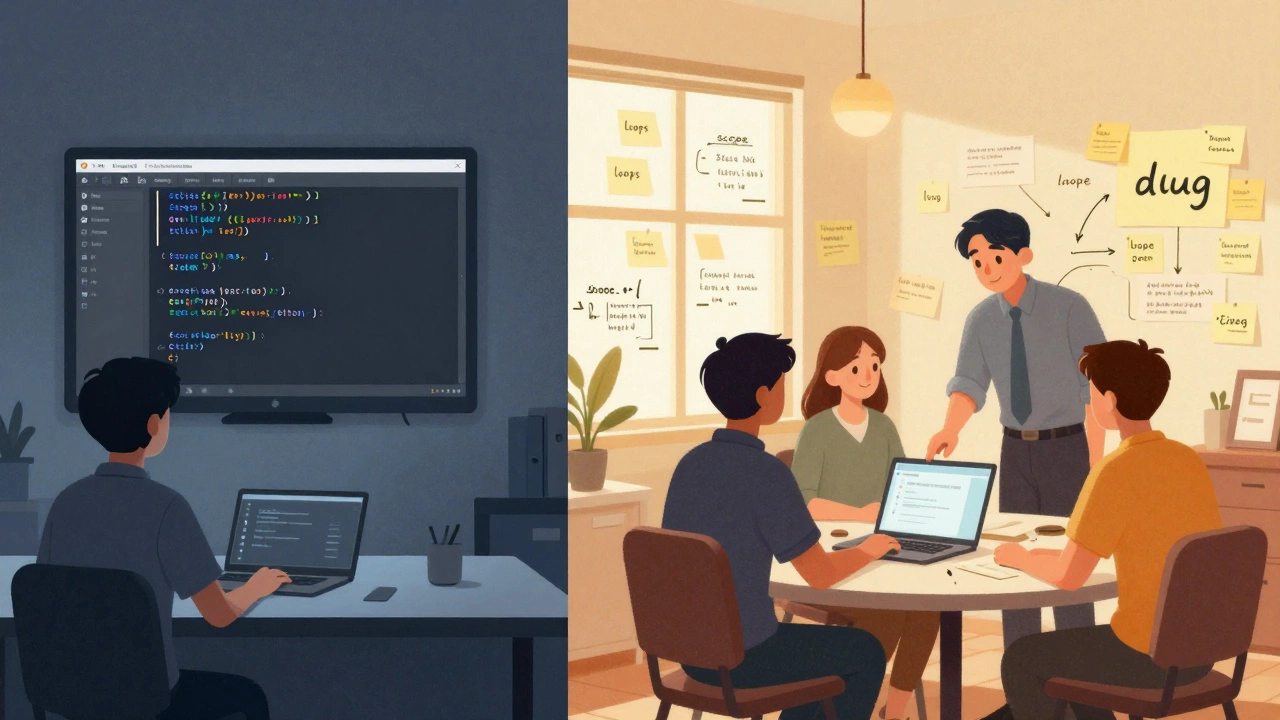
Most people code alone. In silence. With no feedback. No one to ask. No one to review their code. They follow a tutorial, copy the code, run it, and think they got it. But when they try to write something new, they’re lost. Coding isn’t a solo sport. You need to see how others solve the same problem. You need to read real code-not just tutorial code. You need to get feedback. Join a study group. Find a mentor. Contribute to open source-even if it’s fixing a typo in documentation. The moment you start talking to other coders, you stop learning in a vacuum.
They chase shiny tools
Every week, a new framework drops. A new AI tool promises to write code for you. People jump from Python to Rust to Go to TypeScript, thinking each one is the "real" way to code. But here’s the thing: the tools change. The principles don’t. Whether you use JavaScript, Python, or C++, you still need to understand variables, functions, loops, and data structures. Learning a new framework won’t fix your inability to think logically. It’ll just make you a faster beginner. Focus on one language. Stick with it for six months. Build three small projects. Then move on. You’ll be ahead of 90% of people who keep switching.
They don’t practice deliberately
Practicing for hours doesn’t mean you’re improving. You can spend 100 hours typing out code that doesn’t work, and still not get better. Deliberate practice means: solving problems you can’t solve yet. Repeating hard concepts until they’re automatic. Reviewing your mistakes. Fixing them. Not just copying code. Not just following tutorials. Writing code from scratch. Even if it takes 45 minutes to write a function that adds two numbers. That’s the point. Most people avoid struggle. They want to feel smart right away. But growth happens in the discomfort. The code that breaks. The error messages you don’t understand. The bug that takes three days to fix. That’s where you learn.
They expect quick results
YouTube ads promise "Learn to Code in 7 Days!" Bootcamps say "Get a job in 12 weeks!" The truth? Becoming a competent coder takes 6 to 18 months of consistent effort. Not because it’s hard. But because it’s deep. You’re not just learning a skill-you’re learning a new way to think. You’re training your brain to see patterns, to debug systems, to anticipate edge cases. If you’re expecting to build an app in two weeks and get hired, you’re setting yourself up for failure. Progress is slow. It’s messy. It’s full of wrong turns. That’s normal. If you’re not seeing results after three months, you’re not doing it wrong-you’re just early.
They don’t build real projects
Tutorials are great. But they’re not real. When you follow a tutorial, you’re solving someone else’s problem. Real coding means building something that matters to you. A tool that saves you time. A website for your hobby. A script that automates your chores. The moment you build something that solves your own problem, coding stops being abstract. It becomes useful. And useful things stick. I’ve seen people who failed five coding courses suddenly become confident when they built a budget tracker for themselves. Not because it was complex. But because it was theirs.
They fear making mistakes
The biggest blocker isn’t intelligence. It’s fear. Fear of looking stupid. Fear of getting an error message. Fear of asking "stupid" questions. Every coder, even the experts, sees error messages every day. Every line of code you write has bugs. That’s not failure. That’s the process. The best coders aren’t the ones who get it right the first time. They’re the ones who keep going after it breaks. If you’re waiting to feel ready before you start, you’ll never start. Start messy. Start broken. Start confused. That’s where all great coders began.
They don’t track progress
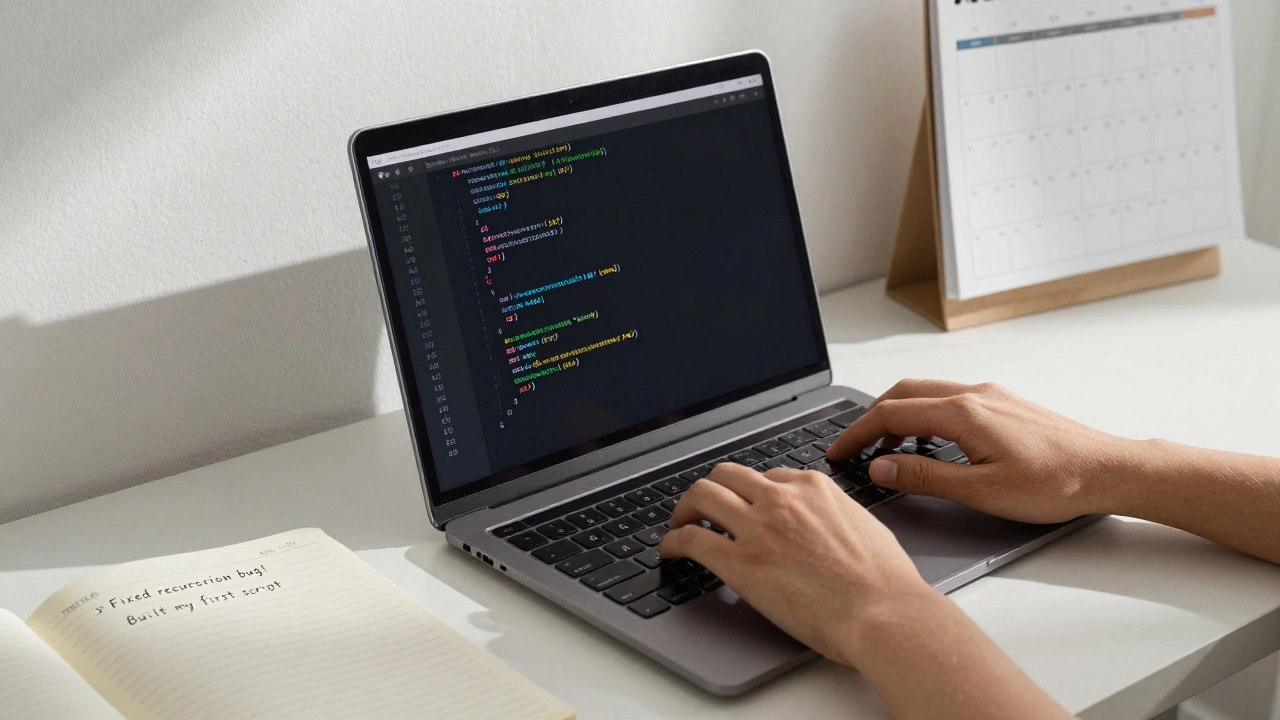
If you don’t measure progress, you don’t know if you’re improving. Did you solve a harder problem this week than last week? Did you write code without copying? Did you fix a bug without Google? Keep a simple log. One sentence a day: "Today I built a calculator that handles negative numbers." Or: "I finally understood how recursion works." Over time, you’ll see how far you’ve come. Most people quit because they feel stuck. But they’re not stuck-they just can’t see the progress.
They compare themselves to others
Social media is full of 19-year-olds building AI apps in two weeks. They’re not lying. But they’re not telling the whole story. Many of them had parents who coded. Or went to schools that taught programming. Or spent years tinkering before they posted their first project. Comparing your Day 1 to someone’s Day 300 is unfair. And it’s destructive. Focus on your own path. Your timeline. Your pace. Progress isn’t a race. It’s a journey.
What actually works
Here’s the simple formula that works for people who stick with coding:
- Choose one language (Python or JavaScript are best for beginners).
- Learn the basics: variables, conditionals, loops, functions, arrays.
- Build one small project every two weeks. No tutorials. Just you and the problem.
- Write code every day-even if it’s just 20 minutes.
- When you get stuck, ask for help. Don’t wait.
- Track your progress. Celebrate small wins.
That’s it. No magic. No shortcuts. Just consistency.
Final thought
Coding isn’t about being a genius. It’s about showing up. Even when it’s frustrating. Even when you don’t understand. Even when you feel like giving up. The people who succeed aren’t the smartest. They’re the ones who keep going. Not because they love coding. But because they love solving problems. And that’s something anyone can learn.
Is coding hard to learn if you’re not good at math?
No. Most coding doesn’t require advanced math. You don’t need calculus to build a website or automate a task. Basic arithmetic and logic are enough. The math you see in games or data science is the exception, not the rule. Focus on problem-solving, not formulas.
How long does it take to get a coding job?
It varies. Some land jobs in 6 months with strong projects and networking. Others take 12-18 months. The key isn’t time-it’s proof. Employers don’t care how long you studied. They care what you built. Build three real projects, show them on GitHub, and start applying. You don’t need a degree. You need a portfolio.
Should I learn Python or JavaScript first?
Start with Python if you want to learn logic, automation, or data. Start with JavaScript if you want to build websites or interact with users. Both are beginner-friendly. Python is simpler to read. JavaScript is everywhere online. Either one works. Pick one and stick with it for at least three months.
Why do coding bootcamps fail so many people?
Bootcamps teach you how to follow instructions, not how to think. They cram you with tools and frameworks, but rarely teach you how to solve new problems on your own. If you don’t practice independently after the bootcamp, you’ll hit a wall fast. The best bootcamps are those that force you to build projects without help-but even then, you still need to keep learning after.
Can I learn coding at 30, 40, or 50?
Absolutely. Age doesn’t matter. What matters is consistency. Many successful coders started in their 30s or 40s. They had more discipline, clearer goals, and better time management than younger learners. The only thing holding you back is believing it’s too late. It’s not.

Dhruv Ainsley
I am an education specialist with a focus on international educational systems, particularly in India. I enjoy exploring how educational practices can be improved to foster better learning environments. Writing about such topics allows me to share insights and encourage meaningful discussions. My work seeks to inspire educational reforms that prioritize inclusive and quality learning experiences.