Jul
10

- by Dhruv Ainsley
- 0 Comments
Career Path ROI & Readiness Calculator
Configure Your Scenario
Enter your details and click calculate to see your projected career path metrics.
Let’s be honest: buying a course doesn’t get you a job. Doing the work does. But picking the *right* course? That saves you months of wasted time and money. In 2026, the job market isn’t looking for people who just watched videos. It’s looking for people who can build things, analyze data, or manage complex projects from day one.
If you are asking, "What is the best course to get a job?" the answer depends entirely on where you want to land. The days of generic "business administration" certificates holding weight are fading. Employers now want specific, verifiable skills. They want to see that you can use Python to clean a dataset, design a responsive website, or run a targeted ad campaign.
The Reality of Hiring in 2026
The landscape has shifted. Ten years ago, a degree was the golden ticket. Today, it’s often just the entry fee. The real differentiator is portfolio-based proof, which is demonstrable evidence of your ability to perform tasks relevant to the role through practical projects rather than theoretical exams.
Recruiters are overwhelmed. They don’t have time to read essays about what you learned in class. They look at GitHub repositories, Behance profiles, or LinkedIn case studies. If your course doesn’t force you to build something tangible, it’s probably not the best investment for your career. We need to move away from passive learning-just watching lectures-and toward active creation.
Also, consider the speed of change. Tools evolve fast. A course teaching outdated software versions is useless. You need platforms that update their curriculum quarterly, not yearly. This is why self-paced online learning often beats traditional semester-long classes for tech and digital roles.
Top Career Paths with High Demand
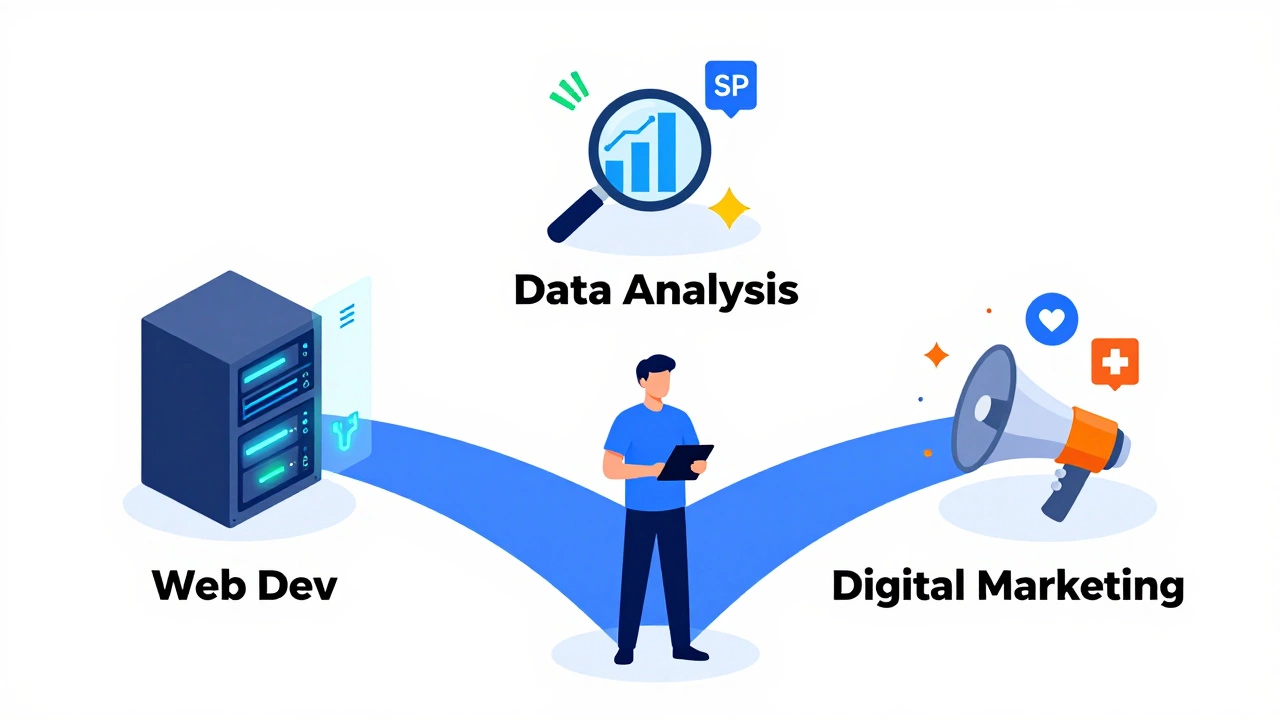
Not all skills pay equally. Some fields offer faster entry points, while others require deeper study but reward you with higher long-term stability. Here are the three biggest buckets where online courses actually lead to employment right now.
- Data Analysis & Visualization: Every company runs on data. They need people who can translate raw numbers into business decisions. You don’t need a PhD in math; you need to know SQL, Excel, and a visualization tool like Tableau or Power BI.
- Web Development & Software Engineering: Code is still the language of the internet. Full-stack development (knowing both front-end user interfaces and back-end server logic) remains a top hiring priority. JavaScript frameworks like React and backend languages like Python or Node.js are standard requirements.
- Digital Marketing & SEO: Businesses always need customers. Specialists who understand search engine algorithms, content strategy, and paid advertising channels are crucial. This field is highly accessible for beginners because you can test strategies immediately.
Other strong contenders include UX/UI Design (focusing on user experience research and interface design) and Cloud Computing certifications (AWS, Azure), though the latter often requires some prior IT knowledge.
Choosing the Right Platform: Udemy vs. Coursera vs. Bootcamps
Where you learn matters as much as what you learn. Different platforms serve different needs. Let’s break down the big players so you can match them to your goals.
| Platform | Best For | Credential Value | Cost Range | Hands-on Practice |
|---|---|---|---|---|
| Udemy | Specific technical skills (e.g., "React 18 Complete Guide") | Low (Certificate of Completion) | $10 - $20 per course | Medium (Code editors included) |
| Coursera | University-backed degrees and professional certificates | High (Recognized by employers like Google, IBM) | $39 - $79 per month subscription | High (Peer-reviewed projects) |
| General Assembly / Le Wagon | Career changers needing structure and mentorship | Very High (Industry partnerships) | $5,000 - $15,000+ | Very High (Live coding, capstone projects) |
| edX | Academic rigor and foundational theory | Medium-High (MicroMasters programs) | $100 - $300 per course | Medium (Automated grading) |
Udemy is a massive open online course platform offering affordable, instructor-led video tutorials on specific technical topics. It’s great if you know exactly what tool you need to learn, like "Advanced Excel Pivot Tables." But beware: quality varies wildly. Always check the last updated date and recent reviews. If a course hasn’t been updated since 2023, skip it.
Coursera partners with top universities and companies like Google, Meta, and IBM to offer structured professional certificates. These are heavier commitments. You pay monthly, and you get graded assignments. The Google Data Analytics Professional Certificate, for example, is widely recognized as a legitimate entry-level credential. It signals to employers that you’ve met a standardized bar of competence.
Bootcamps like General Assembly provides intensive, immersive training programs focused on technology and design careers with career support services. are expensive. Are they worth it? Only if you lack discipline. They provide accountability, career coaching, and networking events. If you’re a self-starter, you can replicate 80% of the curriculum for 10% of the price using free resources and community forums.
The Portfolio: Your Real Resume
This is the most critical part. No matter which course you pick, you must build a portfolio. A certificate says you finished a class. A portfolio says you can do the job.
- For Developers: Build three distinct projects. One should be a clone of a popular app (to show you understand fundamentals), one should solve a personal problem (to show creativity), and one should contribute to an open-source project (to show collaboration). Host these on GitHub.
- For Data Analysts: Find a public dataset (from Kaggle or government portals). Clean it, analyze it, and create a dashboard. Write a blog post explaining your findings. Link to the code and the visualization.
- For Marketers: Start a niche blog or social media account. Document your journey of growing it from zero to 1,000 followers. Use analytics to show how you optimized content. This is live proof of your skills.
Employers love candidates who can walk them through their thought process. When you interview, say, "I built this because I wanted to solve X problem. I chose Y technology because..." That narrative is powerful. It shows strategic thinking, not just button-pushing.
Avoiding Common Pitfalls
I see too many people fall into the "tutorial hell" trap. They watch one video after another, feeling productive, but never write a line of code or create a single chart on their own. This is dangerous. Passive consumption creates an illusion of competence.
Another mistake is chasing trends without understanding foundations. Yes, AI is huge. But before you jump into prompt engineering, make sure you understand basic logic and data structures. Foundational knowledge lasts longer than tool-specific tricks. Learn how to fish, don’t just buy the latest lure.
Also, don’t ignore soft skills. Technical ability gets you the interview; communication gets you the job. Can you explain complex ideas simply? Can you take feedback without getting defensive? Practice presenting your projects to friends or mentors. Record yourself. Improve.

Networking: The Hidden Job Market
Most jobs aren’t posted publicly. They’re filled through referrals. Your course is a gateway to community. Engage with classmates. Join Discord servers, Slack groups, or local meetups related to your field.
When you finish a module, share your project on LinkedIn. Tag the instructor. Ask for feedback. Comment on other learners’ posts. Visibility leads to opportunity. I’ve seen people land jobs simply because a recruiter saw their well-documented project on Twitter/X. Be visible. Be helpful. Be consistent.
In Melbourne, Sydney, and globally, hybrid work is common. Remote-friendly companies value asynchronous communication skills. Show you can document your work clearly. This builds trust with distributed teams.
Final Thoughts on Investment
Treat your education like a business investment. Calculate the ROI. If a course costs $50 and helps you land a freelance gig worth $500, it’s a no-brainer. If a bootcamp costs $10,000, ensure they have a track record of placing graduates in roles that pay above $60,000 annually.
Start small. Pick one skill. Master it. Build something. Then move to the next. The best course is the one you actually finish and apply. Don’t wait for the perfect program. It doesn’t exist. Start today.
Is a certificate enough to get a job in 2026?
Rarely on its own. Certificates prove you studied the material, but portfolios prove you can apply it. Employers prioritize demonstrable skills over paper credentials. Combine a recognized certificate with a strong portfolio for the best results.
How long does it take to become job-ready with an online course?
It depends on the field and your dedication. For digital marketing or basic data analysis, 3-6 months of consistent study (10-15 hours/week) can make you entry-level ready. For software development or UX design, expect 6-12 months to build a competitive portfolio.
Are free courses effective for landing jobs?
Yes, if you are disciplined. Free resources from YouTube, Khan Academy, or official documentation (like MDN Web Docs) are excellent. However, paid courses often provide structure, graded projects, and community support, which help maintain momentum and ensure you cover all necessary topics.
Which skill has the highest ROI for beginners?
Data literacy is currently offering a high return on investment. Almost every industry needs people who can interpret data. Learning SQL and Excel deeply allows you to enter various roles quickly, from marketing analyst to operations coordinator, with relatively low barrier to entry.
Do I need a degree if I take these online courses?
Not always. Many tech and creative roles are becoming more skills-focused. However, some corporate or government positions still require a bachelor's degree. Check job descriptions in your target area. If degrees are mandatory, consider online degree completion programs alongside skill-building courses.

Dhruv Ainsley
I am an education specialist with a focus on international educational systems, particularly in India. I enjoy exploring how educational practices can be improved to foster better learning environments. Writing about such topics allows me to share insights and encourage meaningful discussions. My work seeks to inspire educational reforms that prioritize inclusive and quality learning experiences.