Jan
23
- by Dhruv Ainsley
- 0 Comments
Math in Coding Calculator
How Little Math Do You Actually Need?
You don't need advanced math to code. This calculator simulates real-world operations used in beginner coding projects like websites, apps, and automation tools.
Simple Arithmetic
Basic Comparisons
Real-World Example
Like the article says: "You don't need calculus to build a to-do app. You don't need trigonometry to make a button change color when someone clicks it."
const button = document.getElementById('myButton');
button.addEventListener('click', () => {
if (counter > 10) {
button.style.backgroundColor = '#ff6b6b';
} else {
button.style.backgroundColor = '#4caf50';
}
});
You don’t need to be good at math to learn to code. Seriously. If you’ve ever looked at a line of code and thought, ‘I’m not a math person’, you’re not alone-and you’re not disqualified. Thousands of people who struggled with algebra, hated geometry, or barely passed high school math are now building websites, apps, and automation tools. Coding isn’t about solving equations. It’s about solving problems. And that’s something anyone can learn.
What coding actually requires
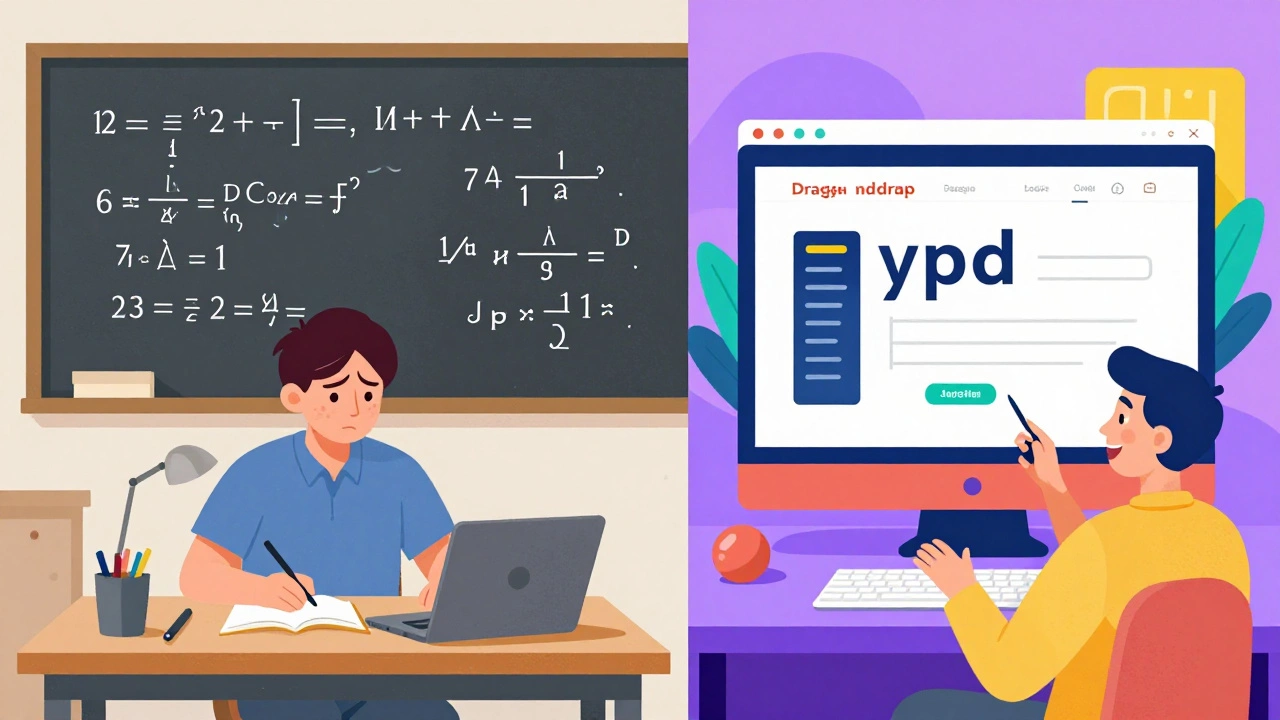
Most beginner coding courses make it sound like you need to be a math genius. That’s misleading. Real-world coding, especially in the early stages, uses basic arithmetic: adding numbers, checking if one value is bigger than another, counting items in a list. That’s it. You don’t need calculus to build a to-do app. You don’t need trigonometry to make a button change color when someone clicks it.
Think of coding like cooking. You don’t need to understand the chemistry of Maillard browning to make a good stir-fry. You just need to follow a recipe, adjust the heat, taste as you go, and learn from mistakes. Coding is the same. You follow patterns, reuse code others have written, and tweak things until they work.
The real skill in coding isn’t math-it’s logic. Can you break a big task into small steps? Can you spot when something doesn’t work and figure out why? Can you stay patient when the computer says ‘syntax error’ for the tenth time? Those are the skills that matter.
What kind of coding doesn’t need math
Not all coding is the same. Some fields, like game development or data science, use more math. But most entry-level jobs and personal projects? Not so much.
Here are real examples of coding you can do with almost no math:
- Building websites with HTML, CSS, and JavaScript-styling buttons, arranging text, making forms work. No math needed.
- Automating tasks like renaming 100 files, sending automatic emails, or pulling data from a website. Just repeat steps and let the computer do the work.
- Creating simple apps like a habit tracker, a recipe organizer, or a note-taking tool. These rely on storing and displaying data, not calculating it.
- Working with content management systems like WordPress or Shopify. You’re using pre-built tools, not writing complex algorithms.
- Writing scripts to organize your photos, clean up spreadsheets, or auto-fill forms. These are all about efficiency, not equations.
Even if you’re not into math, you’ve probably done something like this before: organizing your phone contacts, sorting your music library, or setting up auto-reply emails. Coding is just giving those kinds of instructions to a computer in a language it understands.
Why people think coding = math
The myth that coding requires advanced math comes from a few places. One is university computer science programs, which often start with heavy theory. Another is YouTube tutorials that show complex algorithms-like sorting a list of 10,000 numbers-without explaining that 99% of real-world coding never touches anything like that.
Also, some early programming languages (like FORTRAN or MATLAB) were designed for scientists and engineers. That created a stereotype: if you code, you must be a physicist. But today’s tools? They’re built for regular people. Python, JavaScript, and Ruby are designed to be readable, not intimidating.
And here’s the kicker: most job postings for junior developers don’t list math as a requirement. They list things like ‘willingness to learn,’ ‘attention to detail,’ and ‘ability to debug.’ Those are skills you can build-no calculus required.
What you actually need to start
You don’t need a degree. You don’t need to be good at math. You just need three things:
- Curiosity-wondering how things work, asking ‘why does this button do that?’
- Patience-accepting that you’ll get stuck, and that’s normal. Everyone does.
- Consistency-coding for 20 minutes a day, five days a week, beats cramming for five hours once a month.
Start with a free platform like freeCodeCamp, Codecademy, or The Odin Project. Pick a project that excites you: a personal blog, a simple game, a tool to track your movie watchlist. Build it step by step. When you get stuck, Google the error message. You’ll find answers. Stack Overflow is full of people who started exactly where you are.
Don’t worry about writing perfect code. Write code that works. Then improve it later. The first version of your website might look like a 1998 Geocities page. That’s fine. It’s still a website.
Real stories: people who learned to code without math skills
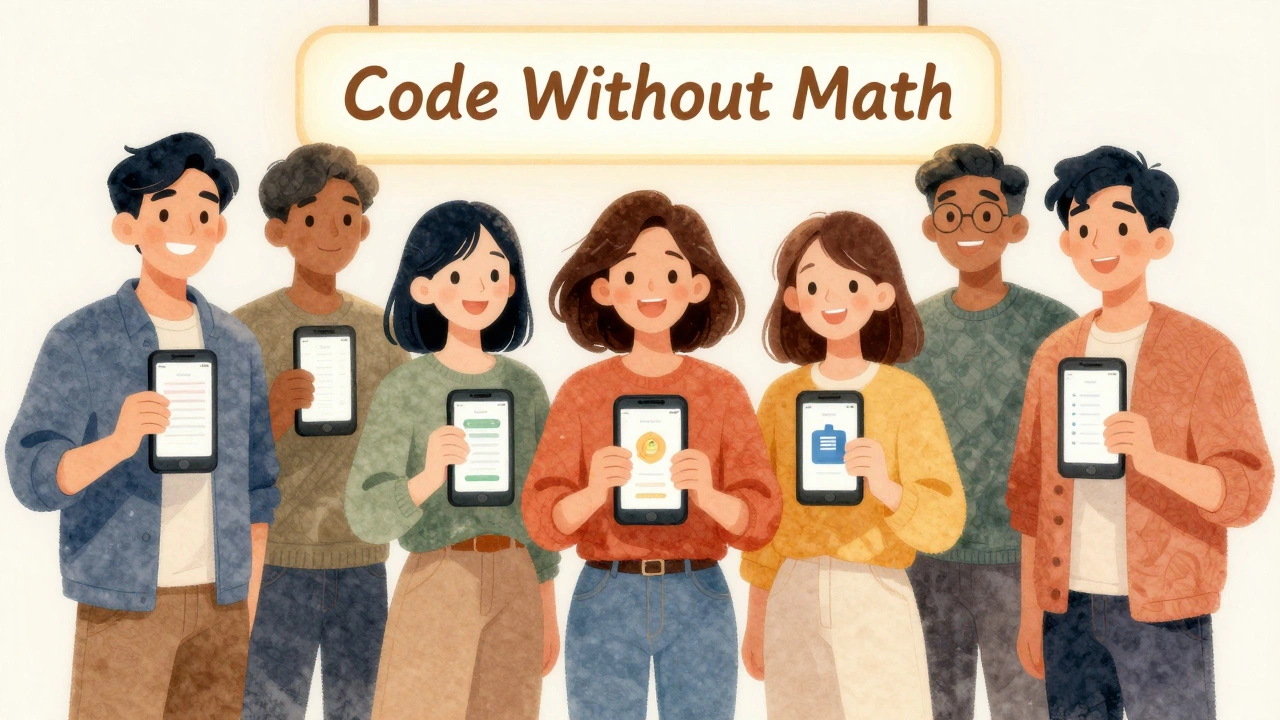
Meet Sarah, a former barista in Melbourne. She hated math in school. She couldn’t balance her checkbook without a calculator. But she wanted to build her own online store for handmade candles. She spent three months learning HTML and CSS on weekends. Today, her shop makes more than her old job-and she didn’t solve a single equation.
Then there’s Raj, who worked in customer service. He was tired of copying and pasting the same responses every day. He learned Python to automate it. Now his team uses his script. He didn’t know what a ‘function’ was six months ago. He just wanted to save time.
These aren’t geniuses. They’re people who saw a problem and decided to fix it with code. Math had nothing to do with it.
What to avoid
Don’t get pulled into tutorials that start with ‘let’s build a neural network’ or ‘how to calculate Fibonacci sequences in Python.’ Those are cool, but they’re not where you should begin. Avoid courses that assume you know algebra. Look for ones that say ‘no experience needed’ or ‘for absolute beginners.’
Also, don’t compare yourself to people who studied computer science. They learned theory. You’re learning practice. Different paths. Same destination.
And don’t wait until you ‘feel ready.’ You’ll never feel ready. Start messy. Start small. Start now.
How to know if you’re making progress
Progress in coding isn’t about solving hard problems. It’s about solving problems you couldn’t solve before.
Here’s how to tell you’re moving forward:
- You can explain what a variable does without memorizing a definition.
- You fix a bug without copying code from Stack Overflow-because you understood why it broke.
- You build something that wasn’t in the tutorial-something you actually wanted.
- You feel proud of a tiny win, like making a button change color.
Those are the real signs of learning. Not test scores. Not math grades. Just small, consistent wins.
Final thought: You’re not behind
You don’t need to be good at math to code. You just need to be willing to try. And if you’re reading this, you already are.
Every expert coder was once a beginner who didn’t know what a loop was. Some of them hated math too. They didn’t wait to feel ready. They just started.
So open your laptop. Pick one thing to build. Type the first line of code. Don’t think about whether you’re smart enough. Think about what you want to create. That’s all that matters.
Do I need to be good at math to become a web developer?
No. Web development mostly uses HTML, CSS, and JavaScript to build and style websites. These rely on structure and logic, not math. You’ll use basic arithmetic-like setting a width to 50% or counting items in a list-but nothing beyond that. Most web developers never touch advanced math in their careers.
Can I learn coding if I failed math in school?
Absolutely. Many successful coders struggled with math in school. Coding isn’t about grades-it’s about problem-solving. If you can follow instructions, notice patterns, and keep trying when something doesn’t work, you have everything you need. Start with simple projects like building a personal webpage or automating a boring task. You’ll see progress fast.
What programming languages are easiest for non-math people?
Python, JavaScript, and HTML/CSS are the easiest for beginners without a math background. Python reads like plain English and is used for websites, automation, and simple apps. JavaScript lets you make websites interactive. HTML and CSS handle layout and design. All three focus on structure and logic, not equations. Avoid languages like MATLAB or R at first-they’re built for math-heavy tasks.
Will I need math for a coding job in the future?
It depends on the job. Most entry-level roles-like front-end development, technical support, or content management-don’t require math. If you later move into data analysis, game design, or machine learning, you might need to learn some math. But that’s years down the road. Start with what you need now. Learn to code first. Add math later, only if you choose to.
How long does it take to learn coding if I’m not good at math?
You can start building simple projects in as little as 4-6 weeks with consistent practice (about 1 hour a day). Building confidence and fluency takes 3-6 months. The key isn’t speed-it’s repetition. You don’t need to understand everything at once. Just keep showing up. The math you think you’re missing? You’ll learn just enough as you go-and often, you won’t even notice you’re learning it.
Next steps: Pick one free coding platform. Spend 15 minutes today clicking through their first lesson. Don’t try to finish it. Just start. Tomorrow, do it again. In a week, you’ll be surprised how far you’ve come.

Dhruv Ainsley
I am an education specialist with a focus on international educational systems, particularly in India. I enjoy exploring how educational practices can be improved to foster better learning environments. Writing about such topics allows me to share insights and encourage meaningful discussions. My work seeks to inspire educational reforms that prioritize inclusive and quality learning experiences.