Jul
24

- by Dhruv Ainsley
- 0 Comments
JEE Study Schedule Generator
Study Tips Based on Your Profile
Select your preferences and click "Generate My Schedule" to see personalized tips.
Your Personalized Daily Schedule
| Time Block | Duration | Activity | Focus Area | Tips |
|---|
Pro Tips for Success:
Weekly Progress Tracker:
Complete each day's schedule to track your weekly progress. Aim for 80%+ completion rate.
It is July 2026. If you are sitting there staring at a stack of textbooks and wondering where to begin your IIT JEE preparation, you are not alone. The Joint Entrance Examination (JEE) remains one of the toughest academic hurdles in India, acting as the gateway to the prestigious Indian Institutes of Technology (IITs). Every year, over a million students attempt this exam, but only a fraction secure a seat in an IIT. The competition is fierce, the syllabus is vast, and the pressure is immense. But here is the truth: success in JEE isn’t about who studies the most hours; it is about who studies with the most clarity.
Many students make the mistake of buying every book on the market or joining five different coaching centers simultaneously. This leads to burnout before they even touch a single question. Instead, you need a structured approach that builds strong foundations, tests your understanding rigorously, and keeps your mental health intact. This guide breaks down exactly how to start, what resources to use, and how to maintain momentum from now until exam day.
Understand the Exam Landscape
Before you open a physics textbook, you need to understand what you are up against. The JEE consists of two stages: JEE Main and JEE Advanced. Think of JEE Main as the qualifier. It is conducted by the National Testing Agency (NTA) and usually happens twice a year-once in January and once in April. Your score here determines eligibility for NITs (National Institutes of Technology) and IIITs, as well as qualifying for JEE Advanced.
JEE Advanced is the real gatekeeper for the IITs. It is conducted by one of the seven zonal IITs on rotation. The questions here are significantly more conceptual and often require multi-step reasoning. You cannot crack JEE Advanced by rote memorization. You need deep conceptual clarity. For 2026, keep an eye on the official NTA website for any changes in the pattern, though the core structure has remained stable: Physics, Chemistry, and Mathematics (PCM), each carrying equal weightage.
Is JEE Main enough for getting into an IIT?
No. JEE Main scores are used for admission to NITs, IIITs, and other GFTIs (Government Funded Technical Institutions). To get into an IIT, you must qualify JEE Main first, and then rank high enough in JEE Advanced. Only JEE Advanced ranks determine IIT admissions.
Build Your Foundation with NCERT
If there is one rule that separates successful candidates from the rest, it is this: master the NCERT books. Many students skip these because they seem "too easy" or "basic." This is a fatal error. The NCERT curriculum, published by the National Council of Educational Research and Training, forms the backbone of the JEE syllabus. In Chemistry, especially, nearly 40% of the questions in JEE Main are directly derived from NCERT lines. Even in Physics and Math, the concepts are introduced here in their purest form.
Start by reading each chapter line by line. Do not just skim. Solve the in-text examples and the exercises at the end of each chapter. If you can solve the NCERT problems without looking at the solution, you have cleared the first hurdle. Only after mastering NCERT should you move to reference books like HC Verma for Physics or RD Sharma for Mathematics. These books add depth and complexity, but they assume you already know the basics. Without a solid NCERT foundation, advanced problems will feel like trying to run before you can walk.
Create a Realistic Study Schedule
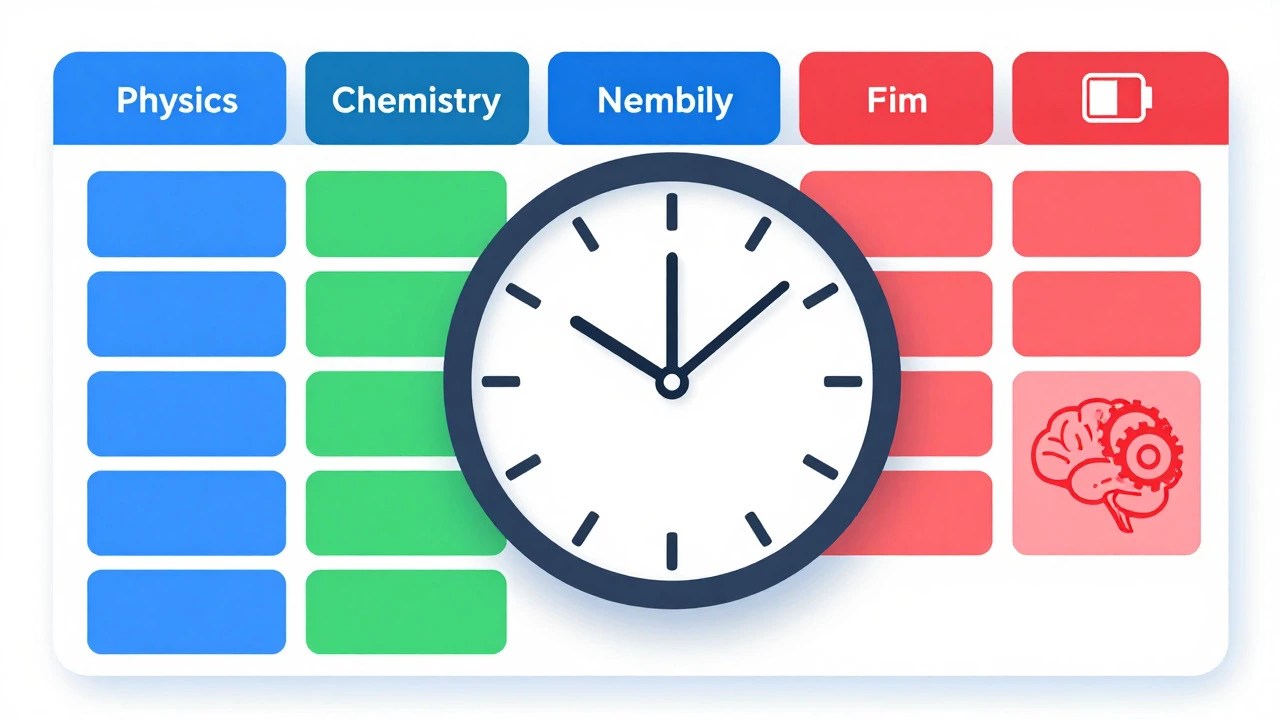
A study plan that says "study 15 hours a day" is a recipe for failure. Humans are not machines. You need a schedule that balances intensity with sustainability. Aim for 6-8 hours of focused study if you are in school, or 10-12 hours if you are in a dedicated drop year. Quality trumps quantity every time.
Divide your day into blocks. Use the Pomodoro technique: 50 minutes of intense focus followed by a 10-minute break. During those 50 minutes, put your phone in another room. No notifications, no social media. Rotate your subjects daily so you don’t get bored. For example, do Physics in the morning when your brain is fresh, Chemistry in the afternoon, and Mathematics in the evening. Include revision time. What you learn today will be forgotten tomorrow unless you review it. Dedicate the last hour of your study day to revising what you covered in the previous week.
- Morning Block: New concept learning (hardest subject)
- Afternoon Block: Problem solving and practice
- Evening Block: Revision and weak area analysis
- Night Block: Light reading or formula memorization
The Power of Mock Tests and Analysis
Studying theory is passive. Taking tests is active. You cannot prepare for JEE without taking full-length mock tests. Start taking them early, even if you haven’t finished the entire syllabus. This helps you build stamina. The JEE exam is three hours long, and maintaining concentration for that duration is a skill in itself.
But taking the test is only half the battle. The real value lies in the analysis. After every mock test, spend twice as much time analyzing it as you did taking it. Why did you miss a question? Was it a calculation error? A conceptual gap? Or did you run out of time? Categorize your mistakes. If you keep making calculation errors, practice arithmetic speed. If you lack concepts, go back to the theory. Track your performance over time. You should see a gradual improvement in both accuracy and speed. Platforms like Allen, Resonance, and online portals offer excellent mock test series with detailed analytics.
| Mistake Type | Reason | Solution |
|---|---|---|
| Calculation Errors | Rushing or poor mental math | Practice daily arithmetic drills; write steps clearly |
| Conceptual Gaps | Incomplete understanding of theory | Re-read NCERT; watch video lectures on specific topics |
| Time Management | Sticking too long on hard questions | Learn to skip; aim for 80% accuracy rather than 100% attempts |
| Reading Errors | Misinterpreting the question | Underline key words; read the question twice |
Subject-Specific Strategies
Each subject requires a different approach. Let’s break them down.
Physics: This is the most application-oriented subject. Focus on understanding derivations rather than memorizing formulas. When you derive a formula yourself, you understand its limits and conditions. Practice numerical problems daily. Start with basic level problems and gradually increase difficulty. Topics like Mechanics, Electrodynamics, and Modern Physics carry significant weight. Make sure you are comfortable with vector algebra and calculus, as they are tools you will use constantly.
Chemistry: Divide Chemistry into Physical, Organic, and Inorganic. Physical Chemistry is like Physics-it involves calculations and concepts. Practice numericals here. Organic Chemistry is about mechanisms. Understand how electrons move. Draw reaction mechanisms repeatedly until they become second nature. Inorganic Chemistry is largely memory-based. Stick strictly to NCERT for this part. Memorize trends, exceptions, and named reactions. Create flashcards for quick revision.
Mathematics: Math is the scoring subject if you are consistent. It requires the most practice. There are no shortcuts here. Solve a variety of problems for each topic. Focus on Calculus, Algebra, and Coordinate Geometry, as they form the core of the syllabus. Learn multiple methods to solve a single problem. This increases your chances of finding a quicker solution during the exam. Keep a separate notebook for important formulas and tricks, and revise it weekly.

Managing Stress and Staying Healthy
JEE preparation is a marathon, not a sprint. Burnout is real. If you ignore your health, your mind will slow down. Sleep is non-negotiable. Aim for 7-8 hours of sleep every night. Your brain consolidates memory during sleep. Cutting sleep to study more is counterproductive. Eat healthy. Avoid excessive junk food and sugary drinks, which lead to energy crashes. Exercise regularly, even if it’s just a 30-minute walk. Physical activity reduces stress hormones and improves focus.
Stay connected with friends and family. Isolation can lead to anxiety. Talk about your fears and doubts. Consider speaking to a counselor if the pressure becomes overwhelming. Remember, your worth is not defined by your JEE rank. It is one step in your journey, not the destination.
Resources and Tools
You don’t need expensive materials to succeed. Here is a curated list of essential resources:
- NCERT Textbooks: For all three subjects, especially Chemistry.
- HC Verma (Concepts of Physics): For building strong Physics fundamentals.
- RD Sharma (Mathematics): For comprehensive Math practice.
- Previous Year Questions (PYQs): Solve at least the last 10 years’ papers. This is crucial.
- Online Platforms: Use platforms like Khan Academy, Unacademy, or Physics Wallah for video explanations if you get stuck.
Avoid hoarding books. Pick one standard book per subject and stick to it. Finish it completely before moving to another. Depth is better than breadth.
Final Months: Revision and Strategy
In the last three months before JEE Main, stop learning new topics. Focus entirely on revision and mock tests. Go through your notes, formula sheets, and mistake logs. Identify your strong and weak areas. In the exam, prioritize questions from your strong areas to secure marks quickly. Don’t get stuck on a difficult problem for more than 5 minutes. Mark it for review and move on. Return to it only if time permits.
For JEE Advanced, the strategy shifts slightly. The questions are tougher and often combine multiple concepts. Practice integrated problems. Work on improving your problem-solving speed and accuracy under pressure. Stay calm. Trust your preparation. You have put in the work. Now, execute it with confidence.
When is the best time to start JEE preparation?
Ideally, start in Class 11. This gives you two years to cover the syllabus thoroughly and revise multiple times. However, starting in Class 12 is still possible if you follow a disciplined, intensive schedule. The key is consistency, not just the starting date.
Do I need to join a coaching institute for JEE?
Not necessarily. Coaching provides structure, peer competition, and regular testing, which can be helpful. However, many students succeed through self-study using online resources and self-discipline. Choose based on your learning style and budget. If you are self-motivated, self-study can be very effective.
How important are Previous Year Questions (PYQs)?
Extremely important. PYQs reveal the exam pattern, difficulty level, and frequently asked topics. Solving them helps you understand the examiner's mindset. Aim to solve at least 10 years of PYQs for both JEE Main and Advanced.
What is the ideal attempt strategy during the exam?
Read the entire paper first. Identify easy questions and solve them first to build confidence and secure marks. Then tackle medium-difficulty questions. Leave the hardest ones for last. Manage your time strictly-spend roughly 1 minute per question initially, and adjust as needed.
Can I crack JEE in a drop year?
Yes, many students improve significantly in a drop year. However, it requires extreme discipline and a fresh perspective. Analyze why you didn't perform well previously, fix those gaps, and avoid repeating the same mistakes. Mental resilience is key during a drop year.

Dhruv Ainsley
I am an education specialist with a focus on international educational systems, particularly in India. I enjoy exploring how educational practices can be improved to foster better learning environments. Writing about such topics allows me to share insights and encourage meaningful discussions. My work seeks to inspire educational reforms that prioritize inclusive and quality learning experiences.