Jul
14
- by Dhruv Ainsley
- 0 Comments
JEE Subject Efficiency Calculator
Your Strategic Analysis
Strategic Recommendation
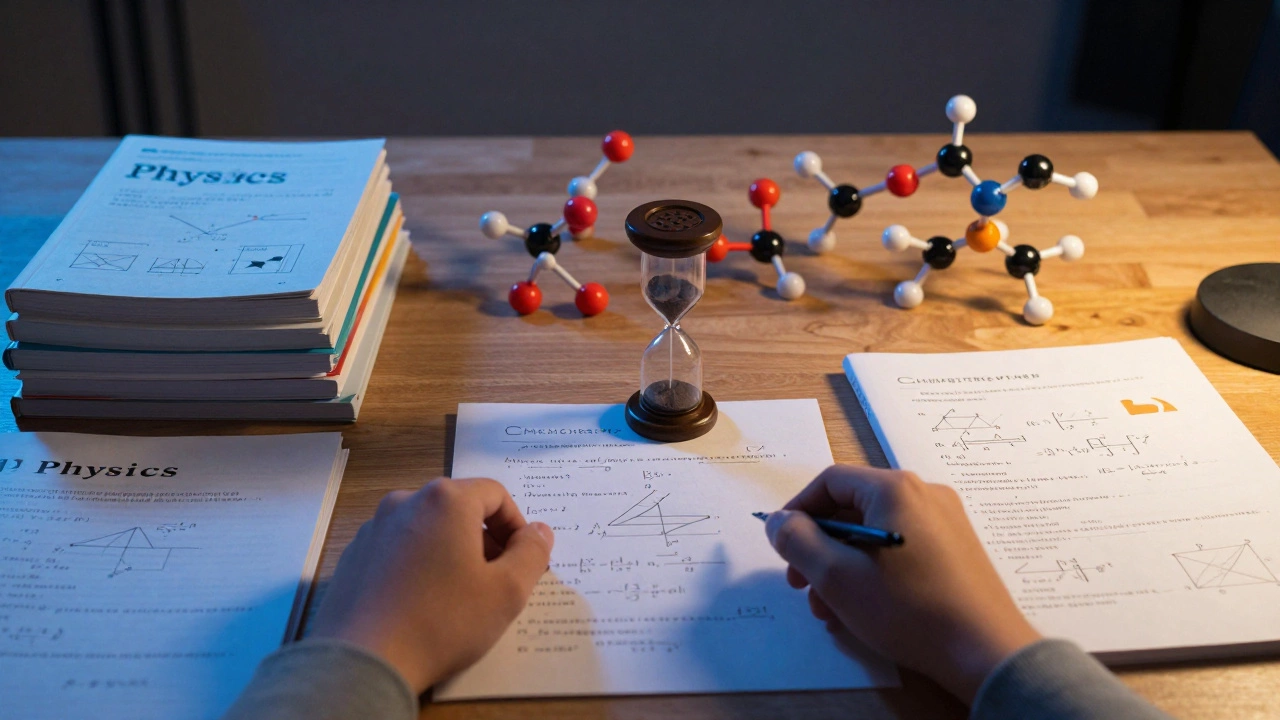
You stare at your syllabus. It looks like a mountain. You have three massive subjects-Physics, the study of matter and energy, Chemistry, the science of substances and their reactions, and Mathematics, the abstract science of number and quantity. You only have so many hours in the day. The question isn't just which one you like best. It's which one gives you the most marks for the least amount of effort. That is the "most scoring" subject.
There is no single magic answer that works for everyone. If you are great at visualizing forces, Physics might be your goldmine. If you love patterns and logic, Mathematics could be your ticket to a top rank. But if you want guaranteed points with minimal calculation time, Chemistry often wins. Let’s break down exactly how each subject performs in the IIT JEE, India's premier engineering entrance examination exams for 2026, and how you can exploit this knowledge.
The Reality of "Scoring" in JEE
Before we pick a winner, we need to define what "scoring" actually means in the context of JEE Main, the first stage of the IIT entrance exam and JEE Advanced, the second, more difficult stage for IIT admission.
A "scoring" subject has two characteristics:
- High Accuracy Potential: You can solve questions correctly without guessing.
- Low Time Consumption: You spend less time per question compared to other subjects.
If a subject gives you 100% accuracy but takes you 4 minutes per question, it is not scoring. You will run out of time. If a subject is fast but you get 50% wrong, it is dangerous because of negative marking. The ideal subject sits in the sweet spot: fast execution and high confidence.
Chemistry: The Safe Bet for Quick Marks
For most students, especially those aiming for a solid rank in JEE Main, Inorganic Chemistry, the branch dealing with non-carbon compounds is widely considered the most scoring part of the exam. Why? Because it requires zero derivation. You don’t need to calculate complex integrals or draw free-body diagrams. You need to remember facts.
Think about it. In Organic Chemistry, you learn mechanisms. Once you understand the electron flow (like nucleophilic attack), you can solve dozens of problems using the same logic. In Inorganic Chemistry, you memorize trends, colors of salts, and exceptions. It’s like learning vocabulary for a language. Once you know the words, you can read the sentences easily.
| Branch | Nature of Questions | Time Per Question | Scoring Potential |
|---|---|---|---|
| Inorganic | Factual, Memory-based | 30-45 seconds | Very High |
| Organic | Logical, Mechanism-based | 1-2 minutes | High |
| Physical | Calculation-heavy, Formula-based | 2-3 minutes | Moderate |
Pro Tip: Don’t ignore Physical Chemistry. While it involves calculations, they are usually simpler than Physics problems. Topics like Chemical Equilibrium and Electrochemistry are formula-driven. If you master the formulas, you can breeze through these questions quickly.
Physics: The Rank Booster
Classical Mechanics, the study of motion and forces is the backbone of Physics in JEE. Many students fear Physics because it feels abstract. However, for students with strong logical reasoning, Physics can be the highest scoring subject.
Why? Because Physics questions in JEE Main are often direct applications of concepts. If you know how to apply Newton’s Laws or Conservation of Energy, you can solve multiple-choice questions rapidly. Unlike Mathematics, where one small algebraic mistake ruins the whole answer, Physics often allows for estimation. You can eliminate options by checking units or limiting cases.
In JEE Advanced, Physics becomes trickier. It tests your conceptual depth. But even there, topics like Modern Physics (Atoms, Nuclei, Dual Nature) are highly scoring. These chapters have fewer sub-topics, less calculation, and high weightage. Mastering Modern Physics is like finding free money in the exam hall.

Mathematics: The Double-Edged Sword
Mathematics is the most volatile subject. For some, it’s the easiest. For others, it’s a nightmare. This variance makes it hard to label as universally "most scoring."
The problem with Math is time. A single integration problem can take 5 minutes if you get stuck on a substitution. In an exam where you have roughly 1 minute per question on average, getting stuck on Math kills your momentum. However, certain chapters are incredibly friendly:
- Vectors and 3D Geometry: These are formula-heavy but logically straightforward. They are often called the "savior" chapters for Math.
- Matrices and Determinants: Simple rules, quick calculations, high accuracy.
- Sequence and Series: Pattern recognition. If you see the pattern, the answer pops out instantly.
If you are weak in Calculus (Limits, Continuity, Differentiation), do not try to force it. Focus on the geometry and algebra chapters that offer better return on investment for your time.
Strategy by Exam Stage
Your definition of "most scoring" changes depending on whether you are taking JEE Main or JEE Advanced.
JEE Main Strategy
In JEE Main, speed is king. The exam is designed to test breadth of knowledge rather than extreme depth. Here, Chemistry is generally the most scoring subject. You can aim for 90-100% accuracy in Chemistry. Use the time saved here to tackle the tougher Physics and Math problems. Treat Chemistry as your safety net. If you secure 30+ marks in Chemistry, you reduce the pressure on the other two subjects significantly.
JEE Advanced Strategy
In JEE Advanced, accuracy is king. The questions are multi-conceptual and lengthy. Here, the "most scoring" subject is the one you have practiced the most. There is no shortcut. However, historically, Physics tends to be slightly more predictable in terms of topic distribution. If you have a strong grasp of Mechanics and Electrodynamics, you can build a stable base. Mathematics in Advanced is often the differentiator between a good rank and a great rank, but it carries the highest risk of error.
How to Identify Your Personal "Most Scoring" Subject
You cannot rely on general advice alone. You need data from your own performance. Follow this simple audit process:
- Take a Mock Test: Solve a full-length JEE Main mock test under timed conditions.
- Analyze Accuracy: Calculate your percentage of correct answers in each subject.
- Analyze Speed: Note the average time taken per question in each subject.
- Calculate Efficiency Score: Divide your Accuracy % by your Average Time per Question (in minutes). The subject with the highest ratio is your most scoring subject.
For example:
- Physics: 80% accuracy, 2 mins/question → Efficiency = 40
- Chemistry: 95% accuracy, 0.5 mins/question → Efficiency = 190
- Math: 60% accuracy, 3 mins/question → Efficiency = 20
In this scenario, Chemistry is clearly your most scoring subject. You should prioritize mastering Chemistry to lock in marks, then use remaining time to attempt easy questions in Physics and Math.
Common Pitfalls to Avoid
Many students fall into the trap of ignoring their weakest subject completely. This is a mistake. Even if Mathematics is not your "most scoring" subject, leaving it blank guarantees zero marks. Instead, adopt a "minimum viable score" approach. Learn the easiest 20% of topics in your weak subject. This ensures you don’t lose easy points.
Another pitfall is over-preparing for JEE Advanced while neglecting JEE Main. Remember, JEE Main scores determine your admission to NITs and IIITs, and they qualify you for Advanced. Do not let perfectionism in one subject ruin your overall ranking.
Final Thoughts on Subject Selection
There is no universal "most scoring" subject in IIT JEE. For the majority of aspirants, Chemistry offers the best balance of speed and accuracy, making it the strategic anchor of your exam. Physics provides the rank-boosting potential if you have strong conceptual clarity. Mathematics is the wild card-it can make or break your score based on your comfort level with calculations.
Your goal is not to love all three subjects equally. Your goal is to maximize your total score. Identify your strengths, play to them, and manage your weaknesses strategically. Use Chemistry to bank points, Physics to climb ranks, and Mathematics to differentiate yourself. That is the winning formula for 2026.
Is Chemistry really easier than Physics in JEE?
It depends on your learning style. Chemistry requires less calculation and more memory/logic, which many find faster. Physics requires deep conceptual understanding and visualization. If you struggle with math, Chemistry will feel easier. If you hate memorization, Physics might be more intuitive.
Which chapter in Physics is most scoring?
Modern Physics (Atoms, Nuclei, Semiconductor Electronics) is widely considered the most scoring chapter. It has limited scope, straightforward formulas, and frequently appears in both JEE Main and Advanced with high weightage relative to its difficulty.
Can I ignore Mathematics if I am bad at it?
No, you cannot ignore it completely. However, you can focus only on high-yield, low-difficulty chapters like Vectors, 3D Geometry, Matrices, and Statistics. These topics require minimal calculus and can help you secure basic marks without extensive preparation.
How much time should I spend on Chemistry daily?
Consistency is key. Aim for 1.5 to 2 hours daily. Spend 30 minutes on Inorganic (reading NCERT), 45 minutes on Organic (mechanisms and practice), and 45 minutes on Physical (numericals). Regular revision is crucial for retaining factual information.
Does the "most scoring" subject change every year?
The trend remains relatively stable. Chemistry consistently offers high accuracy potential due to its factual nature. However, specific chapters may vary in weightage. Always analyze the last 3-5 years' papers to identify current trends, but keep your core strategy focused on balancing all three subjects.

Dhruv Ainsley
I am an education specialist with a focus on international educational systems, particularly in India. I enjoy exploring how educational practices can be improved to foster better learning environments. Writing about such topics allows me to share insights and encourage meaningful discussions. My work seeks to inspire educational reforms that prioritize inclusive and quality learning experiences.