Oct
13

- by Dhruv Ainsley
- 0 Comments
MBA ROI Calculator
Enter your financial details to determine if an MBA makes sense for your specific situation. This tool accounts for both direct costs (tuition) and indirect costs (lost wages).
Your Financial Profile
Investment Analysis
Payback Period
Years to recover total costs from salary increase
ROI Breakdown
- Opportunity Cost (Lost Wages) $0
- Direct Costs (Tuition) $0
- Salary Increase % 0%
Enter your details and click "Calculate ROI" to see your results.
Remember when getting an MBA was the golden ticket to a corner office and a six-figure salary? For decades, that two-year degree was the default path for ambitious professionals. But if you look at job boards and LinkedIn feeds today, the vibe has shifted. People are asking: Is an MBA losing its value?
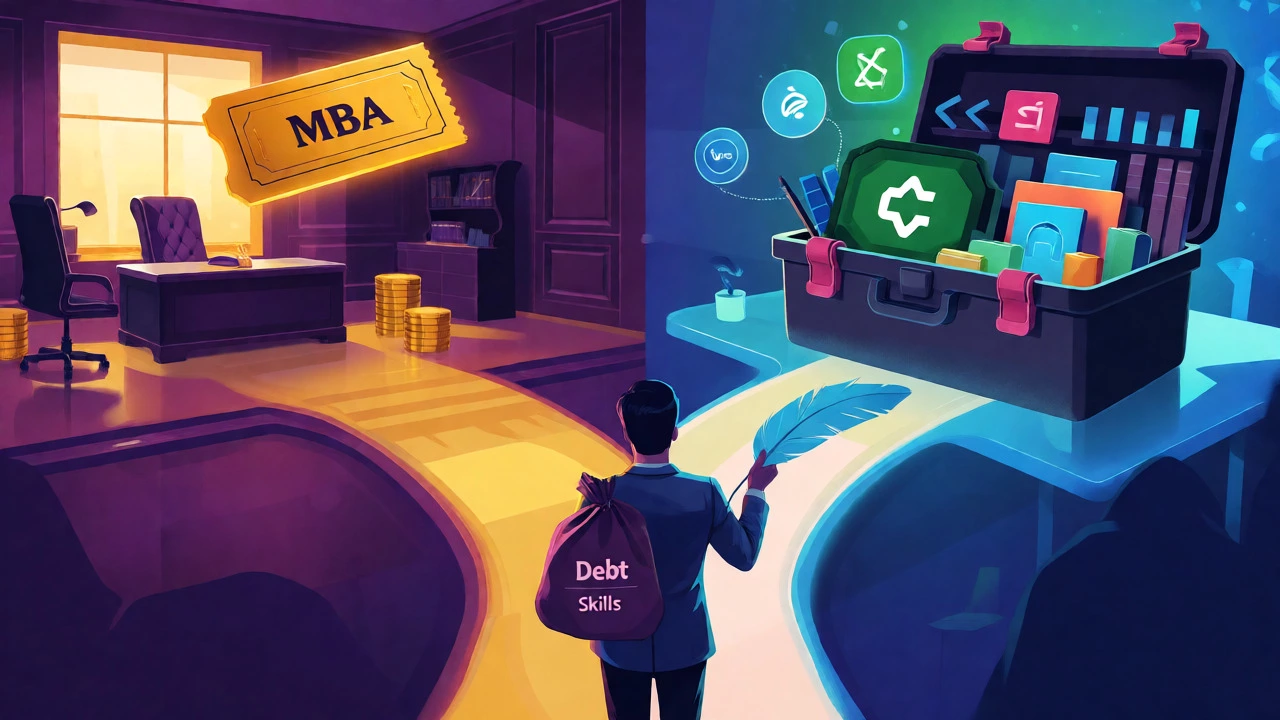
The short answer is no, but the context has changed dramatically. It’s not that the degree is worthless; it’s that the blanket assumption "MBA equals success" is broken. In 2026, the value of a Master of Business Administration depends entirely on where you get it, what you do with it, and how much debt you take on to earn it. If you’re thinking about applying, you need to stop looking at the average stats and start looking at your specific return on investment.
The Shift from Generalist to Specialist
Ten years ago, a general management MBA was enough to pivot careers. You could go from engineering to marketing or finance to consulting just by showing up. Today, employers are more skeptical. They want proof of skills, not just a credential. This doesn’t mean the degree is dead, but it does mean the "generic" MBA is struggling.
Data from the Graduate Management Admission Council (GMAC) shows that while median salaries for MBA graduates have risen, the spread between top-tier schools and mid-tier programs has widened. A graduate from a top-10 program might see a 50-100% salary jump, while someone from a lower-ranked regional school might only see a 10-15% bump, which barely covers the cost of tuition and lost wages. The market has bifurcated. If you aren’t targeting a top-tier institution or a highly specialized niche, the traditional full-time MBA might not pay off as quickly as it used to.
Consider the rise of technical roles. Tech companies like Google and Amazon now hire product managers who understand data science better than they understand corporate strategy. An MBA that doesn’t include hard skills-like Python, SQL, or machine learning fundamentals-is increasingly seen as outdated. The value isn’t in the title; it’s in the toolkit you build alongside the degree.
Cost vs. Reality: The Debt Trap
Let’s talk money, because this is where most people get burned. Tuition fees at top US business schools can exceed $150,000 per year. Add living expenses, and you’re looking at a $300,000+ price tag for two years. That’s before you account for the opportunity cost-the salary you didn’t earn while studying.
Here’s a simple rule of thumb I use with clients: Your post-MBA salary should be at least double your pre-MBA salary within three years of graduation. If it’s not, you’re effectively paying for a lifestyle upgrade rather than a career accelerator. Many candidates ignore this math until they’re drowning in loan payments.
| Scenario | Total Cost (Tuition + Opportunity) | Pre-MBA Salary | Post-MBA Salary | Payback Period |
|---|---|---|---|---|
| Top-Tier Program | $350,000 | $80,000 | $180,000+ | ~4 Years |
| Mid-Tier Regional | $150,000 | $70,000 | $95,000 | ~10 Years |
| Online/Hybrid Part-Time | $80,000 | $75,000 | $90,000 | ~5 Years |
Notice the difference? The top-tier scenario pays off fast because the network and brand name open doors that money alone can’t buy. The mid-tier scenario is risky. Unless you have a strong local network or a guaranteed promotion waiting for you, that ten-year payback period is brutal. The online option is often the safest bet for working professionals who want to avoid the opportunity cost of leaving their job.
Who Actually Needs an MBA Now?
If you’re still on the fence, ask yourself these three questions. If you can’t answer them clearly, hold off on the application.
- Do you need the network? Consulting, investment banking, and venture capital are relationship-driven industries. At firms like McKinsey or Goldman Sachs, the alumni network is part of the product. If you’re trying to break into these fields without connections, an MBA is still a powerful lever.
- Are you hitting a ceiling? Some companies require an MBA for VP-level promotions. Check your company’s internal policy. If your boss says, "Get your MBA, then we’ll talk," that’s a clear signal. But don’t assume every corporation works this way; many tech startups promote based on output, not credentials.
- Do you lack foundational business knowledge? If you’re an engineer or designer moving into leadership, you might genuinely need training in accounting, finance, and organizational behavior. In this case, the education itself is the value, regardless of the brand.
Conversely, if you’re already earning well, have a strong professional network, and just want to "learn more," you might be better off with targeted certifications or executive education modules. Spending $200,000 to learn Excel shortcuts and basic marketing theory is a poor use of capital.

The Rise of Alternatives
The biggest threat to the MBA’s dominance isn’t unemployment-it’s competition. Bootcamps, online certificates, and self-directed learning have democratized business education. Platforms like Coursera and edX offer courses from Wharton and Stanford for a fraction of the cost. While they don’t carry the same prestige, they prove competence.
For example, a Product Manager role often values a certification in Agile methodology or a portfolio of shipped features over a generic strategy course. Similarly, digital marketers rely on Google Analytics and Meta Blueprint certifications, which are updated quarterly, whereas university curricula can lag behind industry trends by years.
This doesn’t replace the MBA for everyone, but it shifts the burden of proof. You can no longer coast on the degree alone. You must demonstrate applied skills. The smartest candidates in 2026 combine the strategic framework of an MBA with the tactical agility of modern digital tools.
How to Future-Proof Your Investment
If you decide to pursue an MBA, don’t just enroll. Engineer the experience to maximize value. Here is a checklist to ensure you’re not wasting time and money:
- Target specific industries: Don’t apply to schools just for the ranking. Look at placement reports. Which companies recruit there? If you want to work in healthcare management, pick a school with a strong hospital partnership pipeline, even if it’s ranked lower overall.
- Specialize early: Choose concentrations in high-growth areas like AI ethics, sustainable finance, or health tech. Avoid vague "general management" tracks unless you are aiming for C-suite roles in large conglomerates.
- Leverage internships: Summer internships are essentially extended job interviews. Treat them as such. Many students treat them as a vacation; those who secure full-time offers treat them as their first day on the job.
- Build a personal brand: Start writing on LinkedIn or building a portfolio during your studies. By graduation, you shouldn’t just be "an MBA grad." You should be "the MBA expert in supply chain optimization." Specificity sells.
The landscape has changed, but opportunity remains. The MBA is no longer a magic wand; it’s a tool. Like any tool, it’s useless if you don’t know how to use it, and dangerous if you spend more acquiring it than you can ever earn back. Be strategic, do the math, and focus on outcomes, not just the diploma.
Is an MBA worth it for career switchers?
Yes, but primarily if you are switching into fields that value pedigree and networks, such as consulting, finance, or general management. For technical switches (e.g., coding), bootcamps or certifications are often faster and cheaper. The MBA provides a structured reset button and access to recruiters who specifically look for diverse backgrounds, but it requires a significant financial commitment.
Do online MBAs have less value than traditional ones?
The stigma around online MBAs has faded significantly. Top universities now offer accredited online programs that are respected by employers. However, the networking component is different. Traditional MBAs offer immersive peer-to-peer learning and spontaneous interactions that are harder to replicate virtually. If your goal is strictly skill acquisition and flexibility, online is excellent. If your goal is breaking into exclusive networks via social capital, traditional may still hold an edge.
How long does it take to recoup the cost of an MBA?
On average, it takes 3 to 5 years for graduates of top-tier programs to break even. For mid-tier programs, this period can extend to 7-10 years or more, depending on salary growth. Key factors include initial debt load, starting salary, and geographic location. High-cost-of-living cities often offer higher salaries, which can accelerate repayment despite higher expenses.
Can I skip an MBA and still reach executive levels?
Absolutely. Many CEOs and executives do not hold MBAs. Experience, performance metrics, and leadership capability matter more than degrees in most industries outside of finance and consulting. If you demonstrate consistent results and strategic thinking, you can climb the ladder without formal business education. However, an MBA can accelerate this process by filling knowledge gaps and providing credibility.
What are the best alternatives to an MBA in 2026?
Popular alternatives include Executive Education short courses, specialized master's degrees (like MS in Data Science or Finance), and professional certifications (PMP, CFA). These options are often more affordable, flexible, and focused on specific skills. They allow you to upskill without pausing your career, making them ideal for professionals who want to deepen expertise rather than pivot entirely.

Dhruv Ainsley
I am an education specialist with a focus on international educational systems, particularly in India. I enjoy exploring how educational practices can be improved to foster better learning environments. Writing about such topics allows me to share insights and encourage meaningful discussions. My work seeks to inspire educational reforms that prioritize inclusive and quality learning experiences.