Apr
28
- by Dhruv Ainsley
- 0 Comments
Coding Career Suitability & Salary Estimator
Part 1: Personality Fit
Answer these honestly to see if you have the "coder's mindset."
Part 2: Salary Potential
Select your current or target skill depth for 2026.
Fit Analysis
Estimated Earnings
The Truth About the Tech Gold Rush
You've probably seen the headlines: a 22-year-old making six figures from a beach in Bali, or the promise that learning to code is the 'new literacy.' But here is the reality in 2026: the days of getting a high-paying job just by finishing a three-month bootcamp are mostly gone. The market has matured. Companies aren't just hiring anyone who knows how to write a loop; they want problem solvers who can navigate a world where AI handles the basic syntax.
So, is coding career a professional path focused on designing, developing, and maintaining software applications using various programming languages still a good bet? Yes, but the 'why' and 'how' have changed. It is no longer a shortcut to wealth, but a robust, scalable skill set that allows you to build actual products. If you enjoy the feeling of staring at a broken piece of logic for four hours and then feeling a rush of dopamine when it finally works, you'll fit right in.
Key Takeaways
- Demand remains high for specialized roles, but entry-level competition is fierce.
- AI tools like GitHub Copilot have shifted the job from 'writing code' to 'system architecture.'
- Soft skills and domain expertise are now just as valuable as technical proficiency.
- Salaries remain competitive, though the growth is now tied to skill depth rather than just tenure.
Beyond the Syntax: What Does a Coder Actually Do?
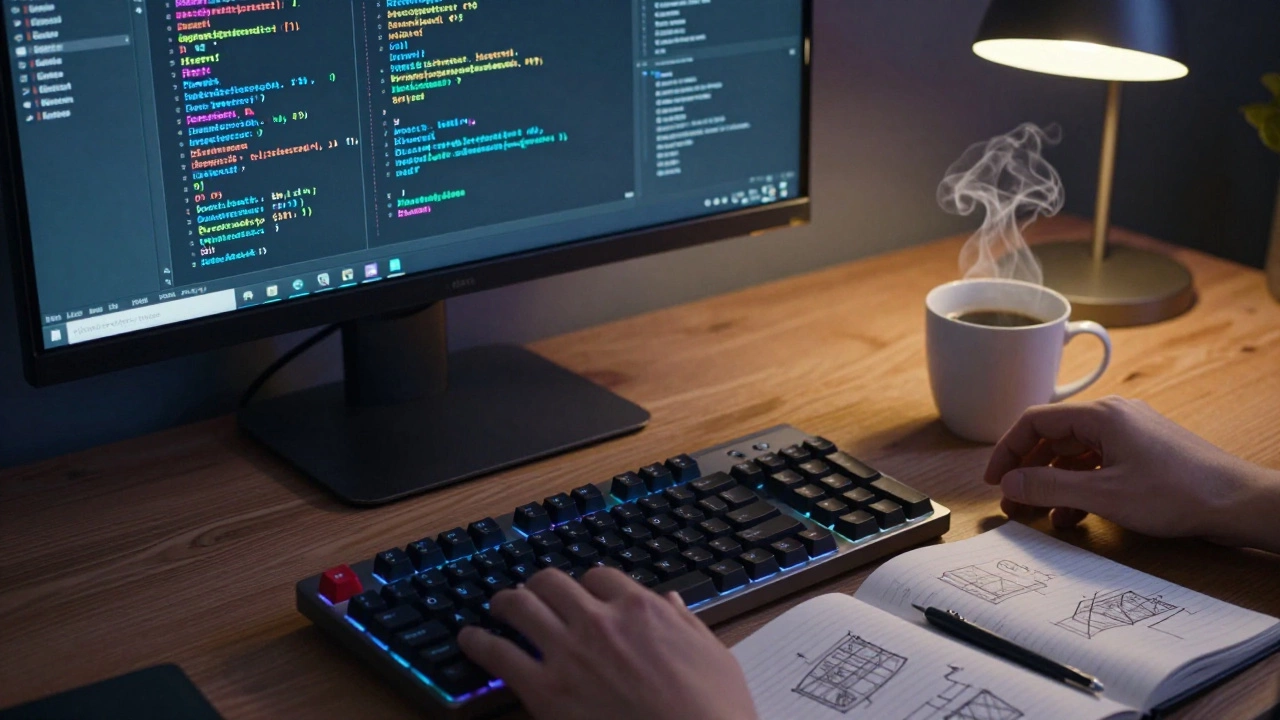
Many people imagine a coder as someone typing frantically in a dark room with green text on a black screen. In a real-world setting, like a fintech startup in Melbourne or a global giant like Google, you spend a surprising amount of time not coding at all. You spend it talking to stakeholders, reading documentation, and arguing about which database structure won't crash when a million people hit the site at once.
A typical day involves Software Engineeringthe application of engineering principles to software development. You'll likely start with a 'stand-up' meeting to coordinate with your team, then spend a few hours in a 'deep work' state tackling a specific ticket. You aren't just writing lines of text; you are managing Version Controlthe practice of tracking and managing changes to software code over time using tools like Git, ensuring your changes don't break the work your teammate did yesterday.
The job is essentially digital puzzle-solving. You're taking a vague business request-'We want users to be able to pay with crypto'-and breaking it down into tiny, logical steps that a computer can understand. If you hate ambiguity and prefer clear-cut answers, this might feel frustrating. But if you love the process of optimization, it's incredibly rewarding.
The Money Talk: Salaries and Growth
Let's be honest: most people ask if coding is a good career because they want to know about the paycheck. While the 'unicorn' salaries are rarer now, the baseline for tech remains higher than most other industries. However, the pay gap between a 'coder' and a 'software architect' is massive.
In 2026, the market has split. Junior developers who only know basic JavaScripta high-level, interpreted programming language used primarily for web development are finding it harder to negotiate high starting salaries. On the other hand, those who understand Cloud Computingthe delivery of computing services over the internet to provide faster innovation and AI integration are seeing their value skyrocket. The money is no longer in knowing the language; it's in knowing how to deploy the solution.
| Role Level | Key Focus | Salary Range (Mid-Market) | Demand Level |
|---|---|---|---|
| Junior Dev | Feature implementation, Bug fixing | $60k - $90k | Moderate/High Competition |
| Mid-Level | System design, API ownership | $100k - $150k | Very High |
| Senior/Staff | Architecture, Scaling, Mentorship | $160k - $250k+ | Critical Shortage |

The AI Elephant in the Room
You can't talk about coding in 2026 without mentioning Artificial Intelligencesystems that mimic human intelligence to perform tasks and improve based on information. There is a persistent fear that AI will replace programmers. Will it? Not exactly. It will replace the *act* of typing code, but it won't replace the *act* of engineering.
Think of AI as a super-powered calculator. When the calculator was invented, mathematicians didn't lose their jobs; they just stopped doing long division by hand and started solving much bigger, more complex problems. Similarly, tools like GitHub Copilotan AI-powered code completion tool that helps developers write code faster handle the boilerplate. The modern developer is now more of an editor and an orchestrator.
To survive and thrive, you need to move up the stack. Instead of focusing on 'how to write a for-loop in Python,' focus on 'how to design a scalable data pipeline' or 'how to secure a user's private data.' The value has shifted from execution to design. If you are okay with being a 'code monkey,' you are at risk. If you want to be an engineer, AI is the best assistant you've ever had.
The Dark Side: Burnout and the 'Always-On' Culture
It's not all remote work and free snacks. Coding can be mentally exhausting. There is a phenomenon known as 'cognitive load' where your brain simply runs out of space to hold the complex map of a large codebase. When you hit a wall, you can't just 'power through' it; sometimes the only solution is to walk away from the screen for a day.
Then there is the sedentary nature of the work. Spending 10 hours a day in a chair is a recipe for back pain and wrist issues. I've seen many talented devs burn out by age 30 because they treated their brains like CPUs-expecting 100% utilization 24/7. The industry often glamorizes 'the grind,' but the most successful long-term coders are the ones who maintain a strict boundary between their terminal and their personal life.
Moreover, the pressure to constantly learn is real. In many careers, you learn the basics and you're set for a decade. In tech, the framework you spent six months mastering today might be deprecated by 2028. You have to be comfortable with being a perpetual beginner. If the idea of studying for the rest of your professional life sounds like a nightmare, this is not the career for you.

How to Actually Start (Without Wasting Your Time)
If you've decided that the challenge is worth the reward, don't just buy a random course. The 'tutorial hell' trap is real-where you follow a video step-by-step, feel like you're learning, but then can't write a single line of code on a blank page.
Instead, start with a project. Want to track your gym progress? Build a simple app for it. Want to know why your favorite website is slow? Use the browser's developer tools to inspect it. The best way to learn Programming Languagesformal languages consisting of a set of strings that produce outputs, of which algorithms are sequences of this programming language is to try to build something, fail miserably, and then search for the specific solution to your problem. That's where the actual learning happens.
When looking at coding classesstructured educational programs that teach programming skills ranging from basic syntax to advanced system design, look for those that emphasize projects over lectures. A bootcamp that gives you a certificate is less valuable than a GitHub profile that shows five working projects you built from scratch. Your portfolio is your real resume in 2026.
Is it Right for You? The Decision Matrix
To decide if this is your path, ignore the salary for a moment. Ask yourself these three questions:
- Do I enjoy the frustration of a problem? If a bug makes you want to throw your laptop, you might hate this. If a bug makes you obsessed with finding the answer, you'll love it.
- Am I okay with constant change? If you want a predictable routine where the rules never change, look elsewhere.
- Can I tolerate solitude? Even in team environments, coding is a solitary act. You spend hours in your own head.
If you answered 'yes' to these, the financial rewards are just a bonus. You'll be entering a field that gives you the power to create something out of nothing. There is a unique kind of freedom in knowing that as long as you have a laptop and an internet connection, you can build a business, solve a problem, or carve out a living anywhere in the world.
Do I need a Computer Science degree to get hired in 2026?
No, but it helps. While many companies still value a degree for its proof of foundational knowledge (like data structures and algorithms), a strong portfolio of real-world projects and a proven track record of contributing to open-source software can often outweigh a degree. However, for high-end roles in specialized fields like AI research or embedded systems, a degree is usually mandatory.
Which programming language should I learn first?
Don't get bogged down in 'language wars.' If you want to build websites, start with JavaScript. If you're interested in data science or AI, go with Python. If you want to build high-performance systems, try Rust or C#. The most important thing is to learn the concepts of logic and architecture; once you understand those, switching languages is relatively easy.
Will AI make entry-level coding jobs disappear?
The 'easy' jobs-like basic HTML updates or simple script writing-are disappearing. However, the need for people who can supervise AI, verify its output, and integrate AI components into a larger system is growing. The entry bar is higher, meaning you need to know more than just syntax to get your first job.
How long does it actually take to become a professional coder?
Depending on your intensity, it typically takes 6 months to 2 years to become 'job-ready.' A bootcamp can accelerate the syntax part, but the 'engineering' part-learning how to write maintainable, scalable code-usually takes a year of consistent practice and a few failed projects.
Is remote work still common in tech?
Yes, though the trend has shifted toward 'hybrid.' Many companies now ask for 2-3 days in the office to improve collaboration and mentorship for junior devs. However, fully remote roles still exist, especially for senior engineers and those working for globalized companies.
Next Steps for Your Journey
If you're feeling overwhelmed, start small. Don't commit to a $15,000 bootcamp on day one. Instead, spend two weeks on a free platform like FreeCodeCamp or Harvard's CS50. If you find yourself losing track of time because you're so focused on a problem, you've found your calling.
For those already in the game, the goal now is 'T-shaped' skills. Be an expert in one deep area (like Backend Infrastructure) but have a broad understanding of others (like UX Design or Product Management). That versatility is what makes you indispensable when the market shifts.

Dhruv Ainsley
I am an education specialist with a focus on international educational systems, particularly in India. I enjoy exploring how educational practices can be improved to foster better learning environments. Writing about such topics allows me to share insights and encourage meaningful discussions. My work seeks to inspire educational reforms that prioritize inclusive and quality learning experiences.