Aug
28

- by Dhruv Ainsley
- 0 Comments
Online Course Decision Helper
Not sure which course to buy? Answer three quick questions to find your ideal learning strategy.
You are scrolling through your phone at 11 PM, coffee cold on the desk, wondering if you should quit your job or just stay stuck. You see an ad for a "Life-Changing Python Bootcamp" next to a "Certified Digital Marketing Masterclass." The pressure is real. But here is the truth: there is no single best course that works for everyone. If someone tells you otherwise, they are selling you something.
The right choice depends entirely on what you want to fix in your life. Do you need money fast? Do you want to switch careers from marketing to tech? Or do you just want to stop feeling bored on weekends? As of August 2026, the online education landscape has shifted. AI tools have changed which skills are valuable. Let’s break down how to pick the right path without wasting months and thousands of dollars.
Defining Your End Goal Before Clicking Buy
Most people fail because they buy courses based on hype, not utility. Ask yourself one question: What problem does this solve? If you cannot answer it in one sentence, close the tab.
There are three main buckets of online learners, and each needs a different type of course:
- The Career Switcher: You need a portfolio and a certificate that employers recognize. Look for project-based programs with mentorship.
- The Skill Upgrader: You have a job but feel outdated. You need micro-credentials or specialized modules (e.g., advanced Excel, SEO updates).
- The Hobbyist: You want joy, not ROI. Look for community-driven platforms where the instructor is engaging, not necessarily famous.
For example, if you are in Melbourne working in retail and want to move into IT, a generic "Intro to Computers" course won't help. You need a specific track like AWS Cloud Practitioner certification preparation. It targets a specific gap in the market. Be precise about your target role before choosing the curriculum.
The Top Contenders by Category in 2026
Let’s look at what actually delivers value right now. I’ve analyzed completion rates and employer feedback from major hiring platforms. Here is where the best value lies.
| Career Path | Recommended Platform/Course Type | Time Commitment | Job Market Demand |
|---|---|---|---|
| Software Development | Full Stack Web Dev (React/Node.js) | 6-9 Months | High |
| Data Analytics | Google Data Analytics Certificate | 3-6 Months | Very High |
| Digital Marketing | SEO & Content Strategy Specialization | 2-4 Months | Moderate-High |
| UX/UI Design | Figma Mastery + Portfolio Build | 3-5 Months | High |
| Project Management | PMP Prep or Agile Scrum Master | 1-3 Months | Stable |
Notice the pattern? The highest demand isn't always in coding. In fact, Data Analytics is currently outperforming general software engineering for entry-level roles because companies already have developers; they need people who can interpret the data those developers generate. If you hate math but love patterns, this is your sweet spot.
Platform Showdown: Coursera vs. Udemy vs. Bootcamps
You might be confused by the sheer number of platforms. Let’s simplify this. Each serves a different purpose.
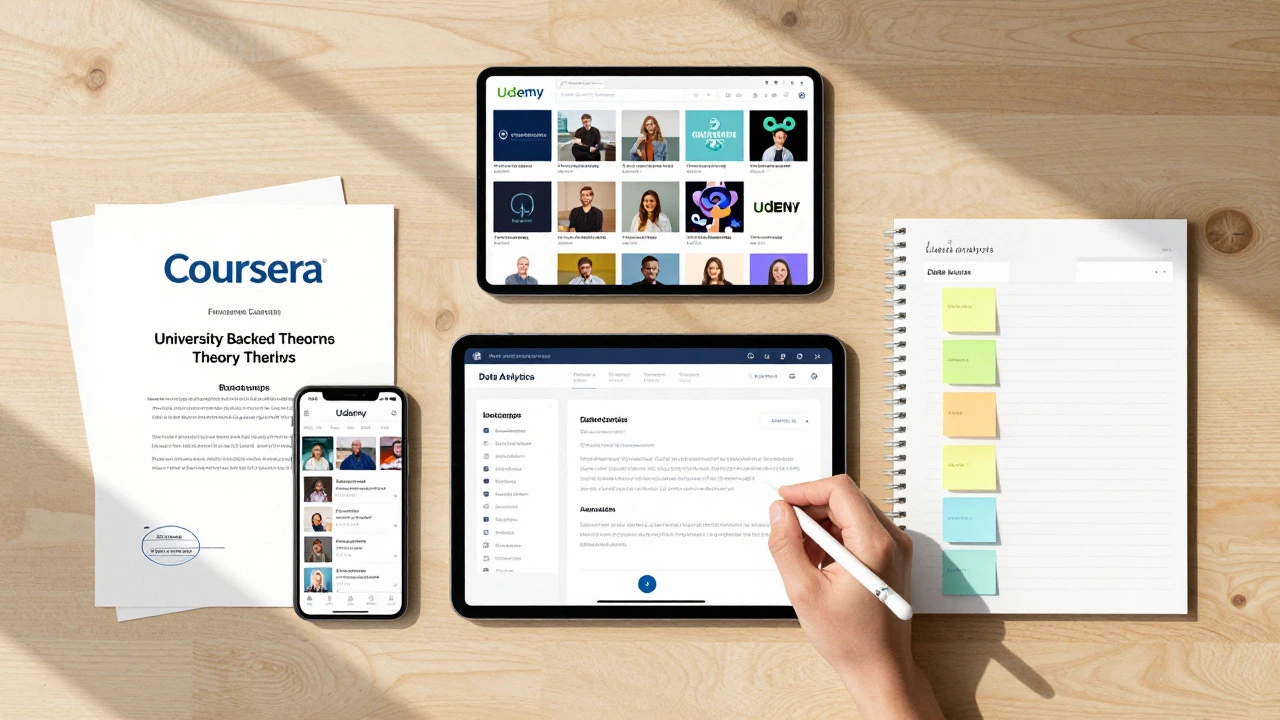
Coursera partners with universities like Stanford and Yale. It is great for theory and recognized certificates. If you need a credential for HR filters, go here. However, it can feel academic and dry. You might learn the history of algorithms but struggle to build a live app.
Udemy is a marketplace where instructors sell individual courses. Prices are low, often under $20 during sales. Quality varies wildly. You must read reviews carefully. Look for courses updated within the last six months. An outdated React course from 2023 is useless in 2026. Udemy is perfect for quick fixes-like learning how to use Notion for productivity or fixing your public speaking anxiety.
Bootcamps are intensive, cohort-based programs costing $10k+. They offer structure and accountability. If you lack discipline, this is worth the investment. But beware of predatory loans. Only choose bootcamps with transparent job placement stats. If they don't publish them, walk away.
How to Spot a Bad Course
Not all shiny objects are gold. Here are red flags that scream "waste of time":
- No Practical Projects: If the syllabus is 90% video lectures and 10% quizzes, you will forget everything in two weeks. Learning happens when you build.
- Outdated Syllabus: Check the last update date. In tech, anything older than 18 months is suspect. In soft skills, it matters less, but check for modern examples.
- Overpromising Results: "Get hired in 30 days guaranteed!" is usually a lie. Hiring depends on your portfolio, interview skills, and luck. No course controls the labor market.
- Lack of Community: Isolation kills motivation. Does the course have a Discord server, Slack channel, or peer review system? If you are alone, you will quit.
I once took a Python course that promised mastery. It had zero code exercises. Just slides. I learned nothing practical. Contrast that with a free YouTube series that forced me to build a scraper every week. The free option won because it demanded action.
The Rise of Micro-Credentials and Stackable Skills
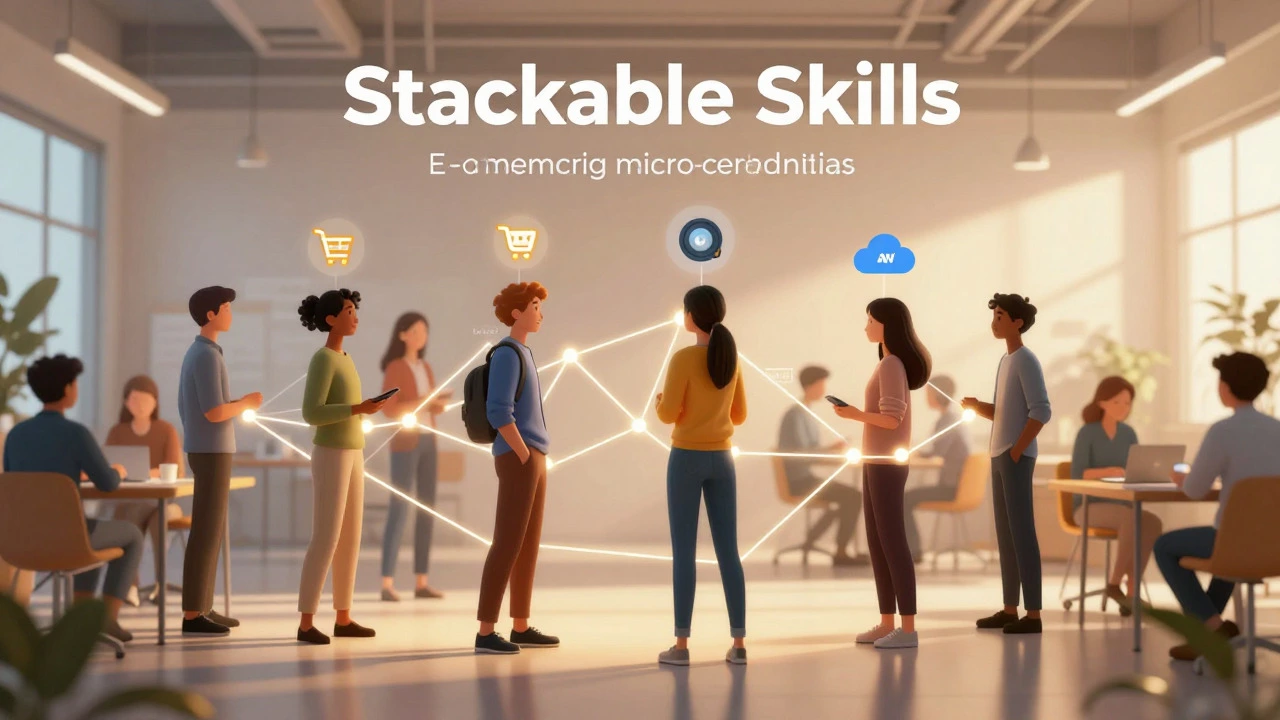
Gone are the days when you needed a four-year degree to prove competence. Employers in 2026 care more about what you can do than where you studied. This has led to the rise of Micro-credentials which are short, focused certifications validating specific skills.
Instead of one massive course, consider stacking small ones. For instance, if you want to work in E-commerce, take a Shopify setup course, then a Facebook Ads certification, then a Customer Service workshop. This modular approach lets you pivot quickly. If ads stop working, you haven’t wasted two years on a full degree. You just add a new module.
This strategy also reduces financial risk. Most micro-credentials cost between $50 and $300. If one doesn’t click, you lose little money and time. Try one first. See if you enjoy the subject matter before committing to a larger program.
Free Alternatives That Actually Work
Do not underestimate free resources. Some of the best learning happens outside paid platforms. Khan Academy remains the gold standard for foundational math and science. For coding, freeCodeCamp offers a comprehensive curriculum with real-world projects. Their community forums are active and helpful.
Why pay when free exists? Because free content lacks structure and accountability. You have to be self-disciplined. If you know you procrastinate, paying for a course acts as a commitment device. You are more likely to finish if you spent $200 than if it cost $0. Use free resources to test interest. Once hooked, upgrade to a structured paid path for depth and certification.
Final Checklist: Making Your Decision
Before you hit enroll, run this quick audit:
- Relevance: Does this skill appear in 5+ job postings for my target role?
- Recency: Was the content updated in the last 12 months?
- Support: Is there a way to ask questions and get answers?
- Outcome: Will I have a tangible artifact (code, design, report) to show at the end?
- Budget: Can I afford this without stress? Financial stress kills learning efficiency.
If you checked all five boxes, go for it. If you missed one, pause and research further. The best course is the one you actually finish. Consistency beats intensity every time.
Is it better to take a university course or an online platform course?
It depends on your industry. For regulated professions like law, medicine, or accounting, accredited university degrees are mandatory. For tech, design, and marketing, online platforms are often preferred because they teach current tools faster than universities. Always check local regulations and employer preferences in your specific region.
How long does it take to complete a typical online course?
Short specializations take 2-4 weeks. Comprehensive professional certificates range from 3-6 months. Full-stack bootcamps typically require 6-9 months of part-time study. Self-paced courses vary wildly based on your weekly hours. Plan for 5-10 hours per week to maintain momentum without burnout.
Do employers respect online course certificates?
Yes, provided the platform is reputable (e.g., Coursera, edX, AWS, Google). However, the certificate alone is rarely enough. Employers prioritize the portfolio or projects you built during the course. The certificate proves you finished; the portfolio proves you can do the work.
Can I learn coding effectively online?
Absolutely. Coding is highly visual and logical, making it ideal for digital instruction. Many successful developers are self-taught or completed online bootcamps. The key is practicing daily and building real projects, not just watching videos. Join coding communities for support and code reviews.
What is the most in-demand online course topic in 2026?
AI literacy and prompt engineering are surging. Additionally, cybersecurity fundamentals and sustainable business practices are seeing high growth. While coding remains strong, the ability to leverage AI tools efficiently is becoming a baseline requirement across many non-tech industries.

Dhruv Ainsley
I am an education specialist with a focus on international educational systems, particularly in India. I enjoy exploring how educational practices can be improved to foster better learning environments. Writing about such topics allows me to share insights and encourage meaningful discussions. My work seeks to inspire educational reforms that prioritize inclusive and quality learning experiences.