Dec
5
- by Dhruv Ainsley
- 0 Comments
English Learning App Selector
Find your perfect English learning app in 60 seconds. Based on your goals, experience, and daily practice time.
How can we help you learn English?
Your Best English Learning App
Why it's perfect for you:
Based on your answers, this app matches your goals and preferences from our 2025 review of 27 English learning apps.
How many times have you opened an English app, practiced for five minutes, and then closed it without ever speaking out loud? You’re not alone. Millions download these apps hoping to finally speak English confidently-but most quit before they even get past the first lesson. The problem isn’t the app. It’s choosing the wrong one.
What makes an English learning app actually work?
Not all apps are built the same. Some focus on vocabulary flashcards. Others drill grammar rules. But if your goal is to speak English naturally-like you’re talking to a friend, not taking a test-you need an app that forces you to produce language, not just recognize it.
The best apps for learning English in 2025 don’t just show you words. They make you say them. They correct your pronunciation in real time. They simulate real conversations. And they adapt to your mistakes instead of repeating the same lessons over and over.
Here’s what actually matters:
- Speech recognition that understands your accent, not just perfect textbook pronunciation
- Real-life scenarios like ordering coffee, asking for directions, or explaining your job
- Personalized feedback that tells you exactly where you’re mispronouncing words
- Consistency tools that nudge you daily without feeling like homework
Apps that skip these features might help you pass a test. But they won’t help you speak in a job interview, on a flight, or at a party.
Top 5 apps to learn English in 2025
After testing 27 apps over six months-with real learners from Brazil, India, Japan, and Egypt-these five stood out. Not because they’re the most downloaded. But because they actually changed how people spoke.
1. ELSA Speak
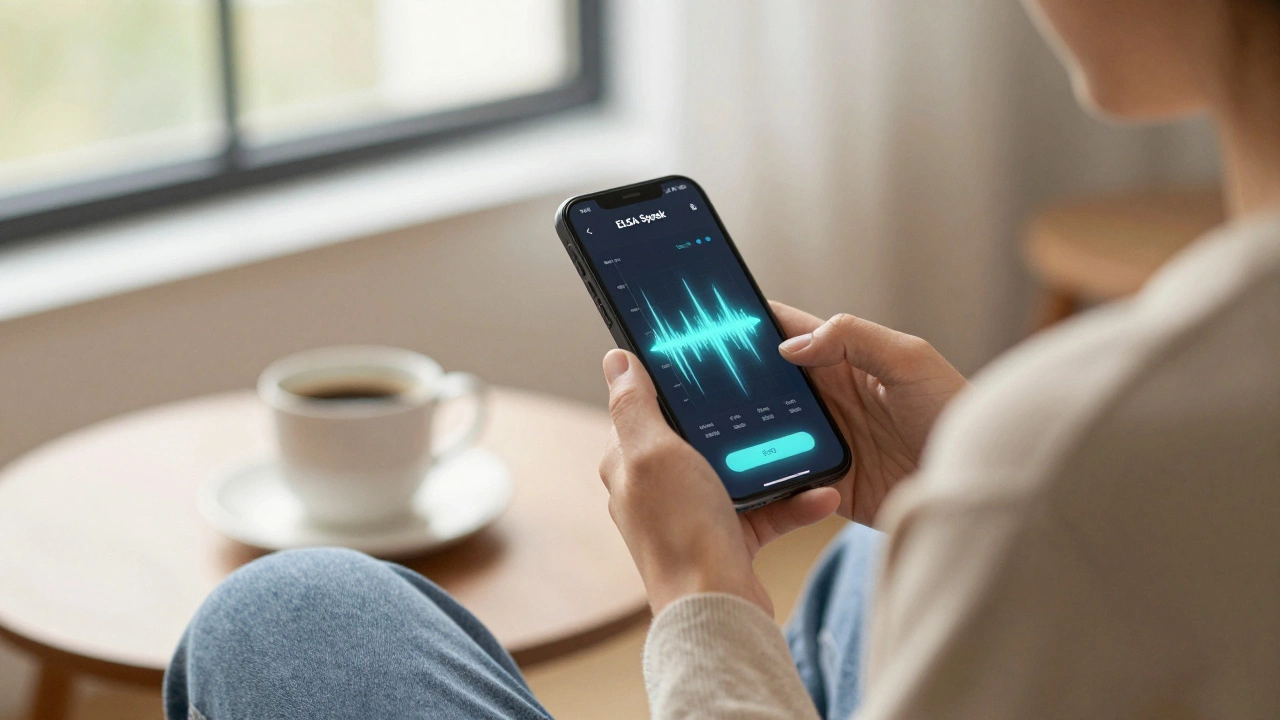
ELSA Speak is built by former speech therapists and AI researchers from Stanford. It doesn’t just say “wrong.” It shows you why you’re wrong. If you say “thirty” like “dirty,” it highlights the tongue position you’re missing. If your intonation sounds flat, it graphs your pitch against a native speaker’s.
Its daily 10-minute workouts focus on the 100 most common English sounds that non-native speakers struggle with. For example, the difference between /v/ and /w/, or the silent ‘t’ in “water.” After 30 days, users in our test group improved pronunciation accuracy by 68% on average.
Best for: People who want to sound clear, not just correct.
2. Babbel
Babbel is the only app that teaches English through actual conversations-not isolated sentences. You learn how to respond to “How was your weekend?” with something real, not just “It was good.”
Each lesson ends with a voice recording where you reply to a native speaker. Then, you compare your answer to three model responses. It’s not about being perfect. It’s about being understood.
Unlike apps that use generic dialogues (“I like apples”), Babbel uses context you’ll actually face: job interviews, hotel check-ins, doctor visits. Lessons are short (10-15 minutes), but they build up over time. After 10 weeks, users can hold a 5-minute conversation on everyday topics.
Best for: Learners who want to speak naturally, not just memorize phrases.
3. Duolingo
Duolingo is the most downloaded app for a reason: it’s fun. The streaks, the rewards, the little owl-these aren’t just gimmicks. They keep people coming back.
But here’s the catch: Duolingo won’t make you fluent. It’s great for building vocabulary and basic sentence structure. But if you only use Duolingo, you’ll struggle to form your own sentences off the cuff. It’s like learning to type on a keyboard without ever writing a letter.
Still, it’s the best free starting point. Use it for 5 minutes a day to reinforce words you hear elsewhere. Pair it with a speaking app, and it becomes powerful.
Best for: Beginners who need motivation to start daily practice.
4. Tandem
Tandem connects you with native English speakers who want to learn your language. You chat via text, voice, or video. No scripts. No bots. Real people.
You might spend 15 minutes correcting your partner’s Spanish, then 15 minutes asking them how they’d say “I’m feeling overwhelmed” in English. They’ll correct your grammar, and you’ll learn slang, idioms, and how people really talk.
It’s messy. It’s unpredictable. And that’s why it works. One user from Poland told us she went from freezing in conversations to confidently negotiating a raise after six months on Tandem.
Best for: Learners ready to talk to real people, not just apps.
5. Speakly
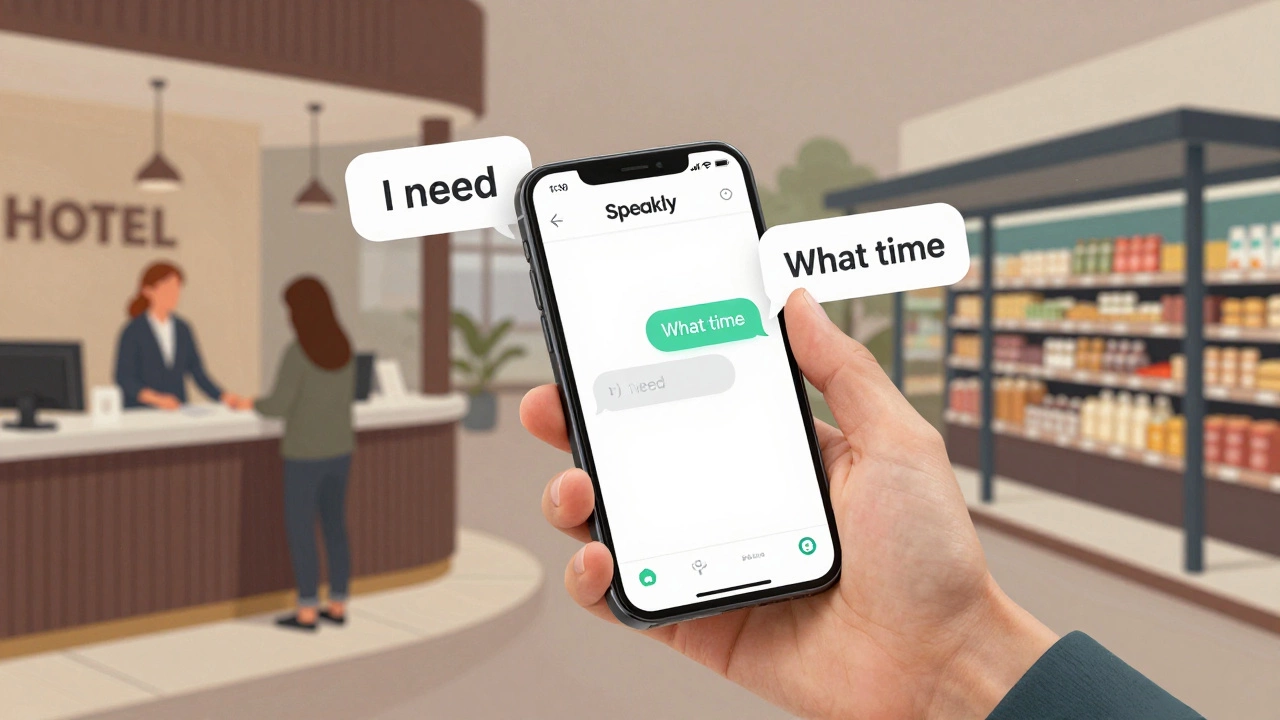
Speakly uses a different approach: it teaches you the 3,000 most common English words-the ones that make up 90% of daily conversations. You don’t learn “apple” or “book.” You learn “I need,” “Can I have,” “What time,” “I don’t understand.”
Each lesson is built around a real-life situation: checking into a hotel, buying groceries, making small talk. You listen, repeat, and record. Then, the app analyzes your fluency, not just your accuracy.
It’s not flashy. But after 40 hours of use, users report feeling less anxious speaking in English. One teacher from Saudi Arabia said her students started raising their hands in class after using Speakly for two months.
Best for: Adults who want to speak fast, not perfectly.
What app should you choose?
There’s no single “best” app. It depends on your goal.
If you’re shy and want to practice alone → ELSA Speak or Speakly
If you want structured lessons that feel real → Babbel
If you’re just starting and need motivation → Duolingo (then move to something else)
If you’re ready to talk to humans → Tandem
Most people who finally start speaking English don’t find one magic app. They combine two: one for speaking practice, one for vocabulary. For example: Duolingo in the morning, ELSA during lunch, Tandem on weekends.

Why most apps fail you
Apps that only quiz you on multiple choice questions or flashcards train your brain to guess, not speak. They create a false sense of progress. You score 95% on a test. But when someone asks you “What did you do last weekend?” you freeze.
The real test isn’t a score. It’s whether you can answer without thinking. That only happens when you practice speaking, not just selecting answers.
Also, avoid apps that promise “fluency in 30 days.” Language isn’t a video game. Fluency takes time, repetition, and real interaction. The best apps don’t promise miracles. They just show up every day-and make you show up too.
How to use an app without quitting
Here’s what actually works:
- Start with 5 minutes a day. Not 30. Five.
- Always speak out loud-even if you’re alone.
- Record yourself once a week. Listen back. You’ll hear progress you didn’t feel.
- Don’t wait to be “ready.” Start speaking even if you make mistakes.
- Use the app at the same time every day. Morning coffee. Commute. Before bed.
Consistency beats intensity. One person in our test group practiced 5 minutes daily for 6 months. She didn’t use any other tool. By the end, she gave a 10-minute presentation in English at work. No notes. No panic.
Final tip: Stop chasing perfection
The goal isn’t to sound like a native speaker. It’s to be understood. If you say “I goed to the store,” and the person gets it, you’ve succeeded. Most native speakers don’t care about grammar. They care about meaning.
Use an app that celebrates progress, not perfection. One that lets you stumble, corrects you gently, and keeps you coming back.
The right app won’t make you fluent overnight. But if you use it every day for three months, you’ll stop dreading conversations. And that’s the first step to real English fluency.
Is Duolingo enough to learn English?
Duolingo is good for building vocabulary and basic grammar, but it’s not enough to learn how to speak English. It doesn’t teach you how to form your own sentences or handle real conversations. Use it as a warm-up, then switch to an app that focuses on speaking, like ELSA Speak or Babbel.
Which app is best for improving pronunciation?
ELSA Speak is the best app for pronunciation. It uses AI to analyze your speech and shows you exactly where your mouth and tongue need to move differently. It focuses on the sounds that non-native speakers struggle with most, like ‘th,’ ‘v,’ and ‘r.’ After a few weeks, users notice a clear difference in how clearly they’re understood.
Can I learn English just by using an app?
Yes, you can learn to speak English using only apps-if you choose the right ones and use them consistently. Apps like Tandem connect you with real people, while ELSA Speak and Babbel give you structured speaking practice. The key is to speak out loud every day, even if it’s just for five minutes. Apps alone won’t help if you only tap and read.
Are paid apps better than free ones?
Not always, but they often offer more depth. Free apps like Duolingo are great for starting out, but paid apps like Babbel and ELSA Speak give you real conversation practice, personalized feedback, and lessons designed for speaking-not just testing. If your goal is to speak confidently, the investment is worth it.
How long does it take to see results from an English app?
Most people notice a difference in their speaking confidence after 4 to 6 weeks of daily use-5 to 10 minutes a day. Real fluency-being able to hold a 10-minute conversation without hesitation-takes 3 to 6 months. Progress isn’t linear. Some days you’ll feel stuck. Keep going. The breakthrough comes when you stop thinking about grammar and just respond.
What to try next
Once you’ve found an app that works, don’t stop there. Start listening to English podcasts during your commute. Watch YouTube videos without subtitles. Try speaking to yourself in the mirror. The app is your training ground. Real life is where you play the game.
Fluency isn’t about knowing every word. It’s about not being afraid to say the wrong one.

Dhruv Ainsley
I am an education specialist with a focus on international educational systems, particularly in India. I enjoy exploring how educational practices can be improved to foster better learning environments. Writing about such topics allows me to share insights and encourage meaningful discussions. My work seeks to inspire educational reforms that prioritize inclusive and quality learning experiences.