Jan
13
- by Dhruv Ainsley
- 0 Comments
Thousands of Indian students dream of cracking JEE every year. But not everyone can afford coaching classes that cost lakhs. So the real question isn’t whether you can self-study for JEE-it’s whether you can do it right. The answer? Yes, you absolutely can. But only if you treat it like a full-time job, not a side hustle.
Why Self-Study Works for JEE
Coaching centers are great for structure, but they’re not magic. Many toppers in recent years-like the 2024 JEE Advanced rank holder from Rajasthan-had zero coaching. They used free YouTube lectures, old question papers, and disciplined routines. The truth is, JEE tests your understanding, not your ability to memorize what a teacher said. If you can explain Newton’s laws without notes, you’re already ahead of half the coaching batch.
Self-study gives you control. You can spend 3 hours on calculus if you’re stuck, or skip 20 minutes of a lecture you already get. No one’s rushing you. No one’s making you sit through a 3-hour class on topics you mastered last week.
What You Need to Start
You don’t need fancy gadgets or expensive apps. Here’s the bare minimum:
- NCERT textbooks for Class 11 and 12 (Physics, Chemistry, Maths)-these are the foundation. Over 60% of JEE Main questions come directly or indirectly from NCERT.
- Previous 10 years’ JEE Main and Advanced papers-download them from the NTA website. Solve them like exams, not homework.
- One reliable reference book per subject-for Physics, H.C. Verma; for Chemistry, O.P. Tandon or J.D. Lee; for Maths, R.D. Sharma and Sk. Goyal for algebra and coordinate geometry.
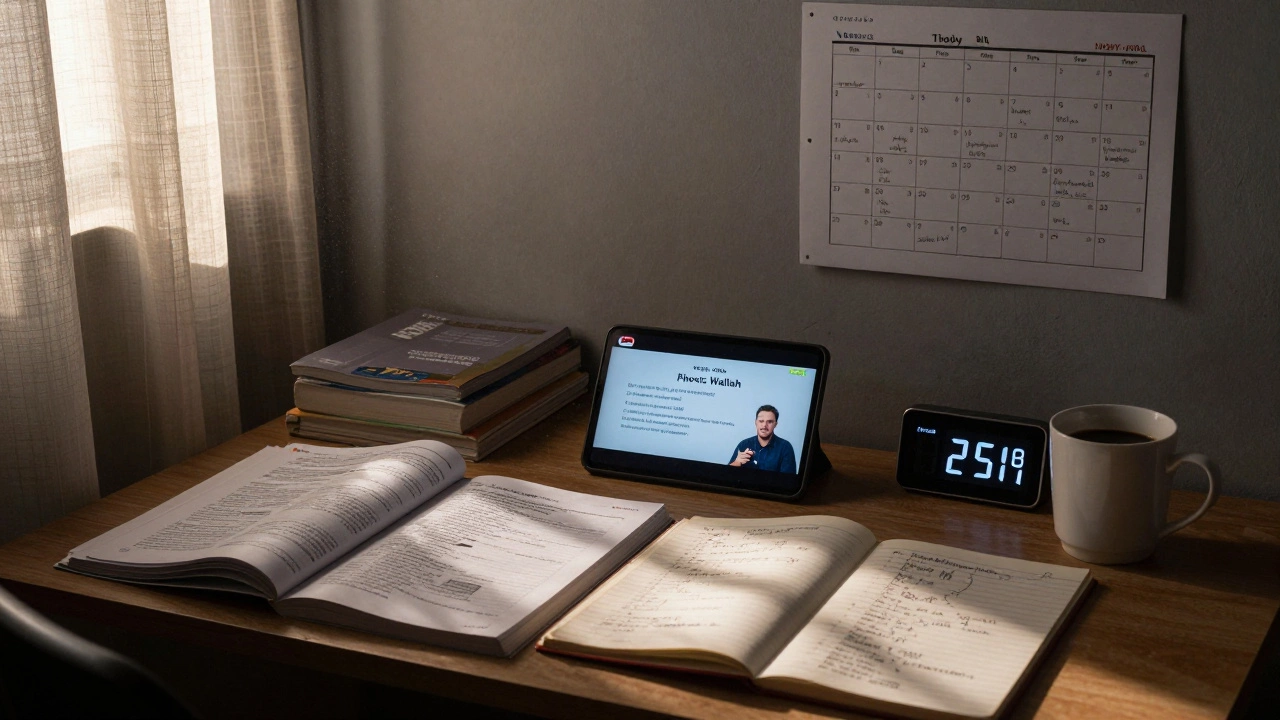
- A quiet study space-not your bed, not the living room. A desk, a chair, and no distractions.
- A free calendar app-Google Calendar or even a printed wall planner. You need to track what you do every day.
How to Build a Realistic Study Plan
Most self-study failures happen because people plan like this: "I’ll study 10 hours a day." That’s not realistic. You’ll burn out in 2 weeks.
Here’s what works:
- Start with 6 hours a day-split into 3 sessions: 2 hours morning, 2 hours afternoon, 2 hours evening. Include 15-minute breaks between each.
- Follow the 70-20-10 rule: 70% time on practice problems, 20% on theory revision, 10% on mock tests.
- Weekly cycle: Monday to Friday = new topics + practice. Saturday = full-length mock test. Sunday = review mistakes and plan next week.
- Track progress: Every Sunday, write down what you learned, what you struggled with, and what you’ll fix next week. No vague notes like "I didn’t get chemistry." Say: "I still mix up SN1 vs SN2 mechanisms. Will rewatch Nitesh Mehta’s YouTube video on nucleophilic substitution."
Example: In January, focus on Class 11 Physics-Kinematics, Laws of Motion, Work and Energy. By March, start integrating Class 12 topics like Electrostatics and Optics. Don’t wait for school to finish. Start early. Start now.
Where to Find Free, High-Quality Resources
You don’t need to pay for video lectures. Here are trusted free sources:
- YouTube: Physics Wallah (Alakh Pandey), Unacademy Atoms, Khan Academy India. Search for "JEE Main Physics NCERT based" or "JEE Advanced Organic Chemistry mechanism".
- NTA Official Website: Download past papers, answer keys, and marking schemes. Analyze the pattern-what topics repeat? What’s the weightage?
- NCERT Exemplar Problems: These are gold. They have harder questions than regular NCERT. Solve every single one.
- Google Scholar and LibreTexts: For deeper theory in Chemistry and Physics, these sites have university-level explanations without paywalls.
Pro tip: Don’t jump between 10 YouTube channels. Pick one teacher you like-for example, Alakh Pandey for Physics-and stick with them. Consistency beats variety.
How to Stay Motivated (When No One’s Watching)
This is the hardest part. No teacher is checking your notebook. No one asks, "Did you finish your assignment?"
Here’s how to fight demotivation:
- Join a study group-even if it’s just 3 friends on WhatsApp. Share daily goals. Send each other a photo of your solved problems. Accountability works.
- Set small wins: "Today I’ll solve 15 integrals without help." When you do it, mark it off. That dopamine hit keeps you going.
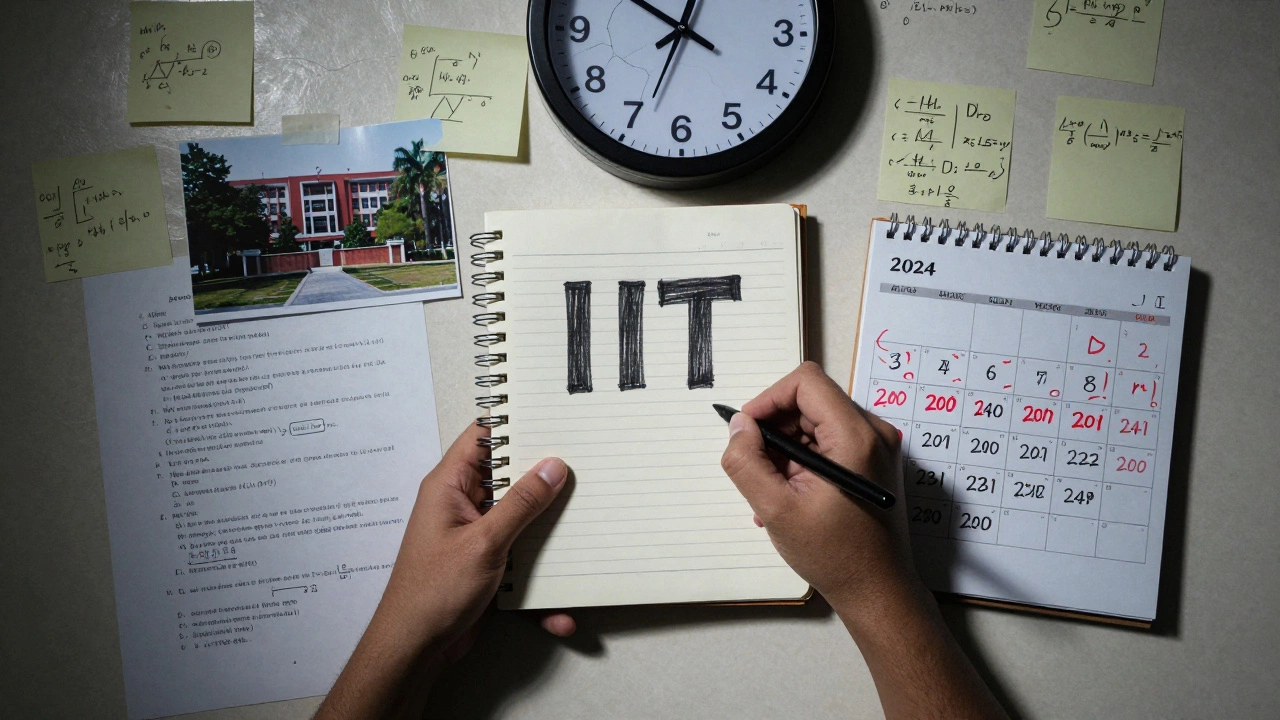
- Visualize your goal: Write "IIT Bombay" or "IIT Delhi" on your wall. Put a photo of the campus as your phone wallpaper. When you feel tired, look at it.
- Take one day off a month-not to binge Netflix, but to recharge. Walk, listen to music, talk to family. You’re not a machine.
Remember: You’re not competing with the coaching topper. You’re competing with the person who gave up last week.
Common Mistakes to Avoid
Here’s what most self-studiers do wrong:
- Collecting resources instead of using them. You don’t need 10 books. One good book + NCERT + past papers is enough.
- Skipping NCERT because it’s "too basic." Wrong. JEE Main 2023 had 12 direct questions from Class 12 Chemistry NCERT.
- Only solving easy problems. If you’re not getting stuck on at least 3 questions a day, you’re not pushing yourself.
- Ignoring weak areas. If you hate Coordinate Geometry, avoid it? That’s how you lose. Drill it until it’s your strength.
- Not timing yourself. JEE is a race. If you take 8 minutes per MCQ, you’ll run out of time. Practice with a timer from Day 1.
Can You Crack JEE Advanced Without Coaching?
Yes. But it’s harder than JEE Main. Advanced tests deeper thinking, not just speed. You need to solve problems you’ve never seen before.
Here’s how to prepare:
- Focus on conceptual clarity over rote learning. Understand why a formula works, not just how to use it.
- Solve past JEE Advanced papers from 2015-2025. Don’t just read solutions-try to solve them again after 3 days.
- Use books like I.E. Irodov (Physics) and Problems in Calculus of One Variable by I.A. Maron (Maths) for advanced-level practice.
- Watch IIT professors’ lectures on NPTEL (free from IITs). They explain things in a way coaching rarely does.
Students who cracked JEE Advanced without coaching usually had one thing in common: they didn’t just study-they thought about what they studied.
When Self-Study Might Not Work
Self-study isn’t for everyone. It won’t work if:
- You’re easily distracted by social media or phone notifications.
- You don’t know how to ask the right questions when stuck.
- You’re studying just to please your parents, not because you want to.
- You’re already behind by 6+ months and haven’t started NCERT.
If any of these sound like you, consider joining a low-cost online batch-like those offered by BYJU’S or Unacademy for ₹500/month. It’s not coaching, but it gives you structure. Better than nothing.
Final Advice: The Mindset That Wins
Self-study for JEE isn’t about being the smartest. It’s about being the most consistent.
One student from Bhopal, Class 12, started with 30% in her mock test. She studied 5 hours a day, missed only 2 days in 10 months, and got a rank under 500 in JEE Advanced. She didn’t have a tutor. She didn’t have money for coaching. She had a notebook, a calendar, and the will to keep going.
You can do the same. Start today. Not tomorrow. Not after Diwali. Today.
Can I self-study for JEE if I’m weak in maths?
Yes, but you need to start with the basics. Rebuild your foundation using NCERT Class 11 Maths. Focus on algebra, trigonometry, and functions first. Solve every example and exercise. Then move to R.D. Sharma. Practice 20 problems a day-even if they’re easy. Speed comes after accuracy. Don’t skip topics because they’re hard. Face them daily.
How many hours should I study daily for JEE self-study?
Start with 5-6 focused hours a day. Quality matters more than quantity. Studying 10 hours while distracted is worse than 6 hours of deep work. Include breaks. Sleep 7 hours. Your brain needs rest to retain what you learn. As you get closer to the exam, increase to 7-8 hours, but never sacrifice sleep.
Is NCERT enough for JEE Main?
NCERT is the base, but not enough alone. For JEE Main, you need to practice previous years’ papers and solve MCQs from books like O.P. Tandon (Chemistry) and R.D. Sharma (Maths). NCERT gives you 60-70% of the content. The rest comes from applying concepts to new problems.
Can I crack JEE Advanced with only YouTube videos?
YouTube alone won’t get you there. Videos explain concepts, but JEE Advanced tests problem-solving under pressure. You need to solve 100+ problems daily, timed. Use YouTube to learn, then use past papers to test yourself. If you only watch and never solve, you’ll fail.
What if I don’t have a good internet connection?
Download videos when you have Wi-Fi. Use apps like YouTube Offline or save PDFs of NCERT and reference books. Many students in rural India cracked JEE with just printed notes, a flashlight, and a notebook. Books and practice papers are your real tools-not internet speed.
Is self-study better than coaching?
It’s not better or worse-it’s different. Coaching gives structure and peer pressure. Self-study gives freedom and personal responsibility. If you’re disciplined, self-study is more effective. If you need someone to push you, coaching helps. But coaching won’t save you if you don’t work. Only you can do that.
Start today. One problem. One page. One hour. That’s how legends are made-not in coaching centers, but in quiet rooms, with a notebook and a stubborn will.

Dhruv Ainsley
I am an education specialist with a focus on international educational systems, particularly in India. I enjoy exploring how educational practices can be improved to foster better learning environments. Writing about such topics allows me to share insights and encourage meaningful discussions. My work seeks to inspire educational reforms that prioritize inclusive and quality learning experiences.