Jan
6
- by Dhruv Ainsley
- 0 Comments
Coding Salary Calculator
Enter your details to see your estimated salary range
How much money do you actually make from coding? It’s not the same for everyone. Some fresh grads start at $50,000 a year. Others with five years of experience earn over $150,000. And then there are freelancers who make $200 an hour-or nothing at all for months. The truth? Coding pays well, but only if you know where to aim.
What kind of coding job pays the most?
Not all coding jobs are created equal. The highest earners aren’t always the ones who write the most lines of code. They’re the ones solving hard problems in high-demand areas.
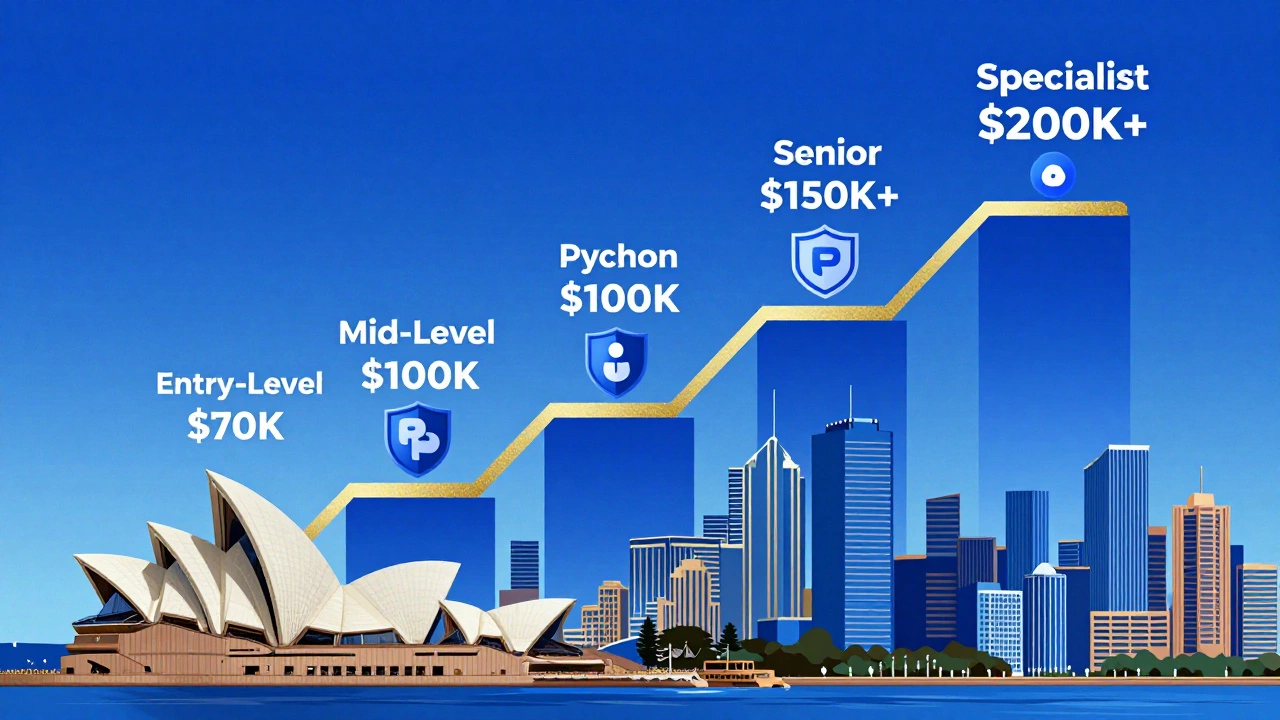
Software engineers at big tech companies like Google, Amazon, or Meta in Australia average $135,000 to $180,000 a year, including bonuses. That’s before stock options. In Melbourne, a senior full-stack developer at a fintech startup can make $140,000 with 5-7 years of experience. The top 10%-those working on AI systems, cloud infrastructure, or cybersecurity-often clear $200,000.
But if you’re building mobile apps for small businesses or doing basic WordPress tweaks, you’re looking at $60,000-$80,000. There’s a big gap between coding and high-value coding.
Entry-level salaries: What can you expect as a beginner?
If you just finished a coding bootcamp or a certificate course, don’t expect $100,000 right away. In Australia, entry-level developers typically start between $65,000 and $80,000. That’s true whether you learned Python on Udemy or went through a TAFE program.
Companies like Atlassian, Canva, and Afterpay hire junior devs straight out of bootcamps. But they want more than just syntax knowledge. They look for:
- Projects you built yourself-not just class assignments
- Understanding of Git and basic DevOps
- Ability to explain how your code works in plain English
One graduate from a Melbourne coding bootcamp landed a $72,000 job at a health tech startup because she built a real-time appointment scheduler for a local clinic. She didn’t have a degree. She had a working app and clear reasoning behind her choices.
Freelancing vs full-time: Which pays better?
Freelance coders have more control over their time-but less stability. In Australia, freelance developers charge between $50 and $150 an hour. That sounds great until you factor in taxes, superannuation, and months with no work.
Here’s the math: A freelancer charging $80/hour, working 30 hours a week for 48 weeks a year, makes $115,200. Sounds good? Now subtract 30% for taxes, software subscriptions, health insurance, and downtime. That leaves $80,000. And that’s if you’re consistently busy.
Full-time jobs give you paid leave, health insurance, training budgets, and predictable income. Many freelancers end up working longer hours than employees just to make the same money.
Best case? A freelancer with a niche-like building Shopify stores for Australian retailers-can hit $120,000+ by focusing on repeat clients and scaling with subcontractors.
Location matters-especially in Australia
Salaries in Sydney and Melbourne are 15-20% higher than in Brisbane or Adelaide. But so is rent. A $90,000 salary in Melbourne feels different than $80,000 in Perth, where housing costs are half.
Remote work has changed the game. Some Australian companies now hire developers from regional areas and pay the same as Sydney rates. Others offer lower salaries if you live outside major cities.
Companies like Xero and REA Group hire remotely across Australia. But if you’re applying to a small business in Townsville, expect $60,000-$75,000-even if you’re skilled.
Specialized skills = higher pay
Generalists get paid well. Specialists get paid a lot more.
Here’s what’s in demand in 2026:
- AI/ML engineers: $140,000-$220,000 (Python, TensorFlow, PyTorch)
- Cloud architects: $130,000-$190,000 (AWS, Azure, Kubernetes)
- Cybersecurity engineers: $120,000-$180,000 (pen testing, SOC, compliance)
- DevOps engineers: $115,000-$170,000 (CI/CD, Terraform, Docker)
- Mobile developers (iOS/Android): $90,000-$140,000
- Web developers (React, Node.js): $75,000-$110,000
Learning React alone won’t make you a $150k developer. But learning React + Next.js + TypeScript + AWS deployment? That’s a package companies pay top dollar for.
How fast can you earn more?
Most coders see their salary jump 20-30% after 2-3 years. But the biggest leaps come from switching roles-not just staying put.
One developer I know started at $68,000 as a junior backend dev. After two years, he moved from a local bank to a fintech startup. His new salary: $105,000. He didn’t get a promotion. He changed companies.
Switching jobs every 2-3 years is the fastest way to grow your income in tech. Staying at one company for five years without moving roles? You’ll likely earn 15-20% less than peers who switch.
What skills don’t pay well?
Not every coding skill has a paycheck attached. Here are the ones that rarely lead to high pay:
- Basic HTML/CSS (unless paired with frontend frameworks)
- Old-school PHP (without Laravel or modern practices)
- WordPress theme customization (unless you’re building custom plugins at scale)
- Excel macros or VBA (unless you’re in finance automation)
These skills can get you a job, but they’re not career accelerators. They’re entry points. To grow, you need to layer on more valuable skills.

Real numbers: What does a coding career look like?
Let’s map out a real path in Australia:
- Year 1: $68,000 as a junior dev at a small agency
- Year 3: $95,000 after learning React and Node.js, promoted internally
- Year 5: $130,000 after switching to a fintech company, adding cloud skills
- Year 7: $175,000 as a senior engineer leading a team, with stock options
That’s not fantasy. That’s what people in Melbourne, Sydney, and Brisbane are doing right now.
What’s holding people back?
The biggest mistake? Sticking to one language or tool too long. Many beginners think, “I learned Python, I’m set.” But Python alone won’t get you a $150k job. You need context: databases, APIs, deployment, testing, collaboration.
Another problem? Waiting for the “perfect” course. There’s no magic bootcamp. What matters is building real stuff, getting feedback, and shipping code-even if it’s messy.
One person I spoke to spent six months learning React, then built a real estate search tool for a local agent. He didn’t ask for pay. He just asked for a reference. Three months later, he got a job offer for $82,000.
It’s not about how much you learn. It’s about what you build and who sees it.
Final reality check
Coding doesn’t guarantee wealth. But it does open doors that other careers don’t. You don’t need a degree. You don’t need to be a genius. You just need to be consistent.
Salaries are high because demand is high. But the people who earn the most aren’t the ones who started first. They’re the ones who kept learning, kept building, and kept moving toward harder problems.
If you’re serious about making money from coding, focus on:
- Building real projects, not tutorials
- Learning tools companies actually use-not just trendy ones
- Getting feedback from real developers, not just online forums
- Switching jobs to grow, not just staying comfortable
It’s not about how much you start with. It’s about how fast you grow.
How much do beginner coders make in Australia?
Beginner coders in Australia typically earn between $65,000 and $80,000 a year. This applies to those with coding bootcamp certificates, TAFE qualifications, or self-taught skills. Companies like Atlassian and Canva hire juniors with strong project portfolios, even without degrees.
Can you make $100,000 coding without a degree?
Yes. Many developers in Australia earn over $100,000 without a university degree. What matters is skills: building real apps, using modern tools like React, Node.js, or cloud platforms, and showing you can solve problems. Employers care more about what you’ve built than where you studied.
Is freelancing better than a full-time coding job?
It depends. Freelancers can earn more per hour, but they also face gaps in work, pay their own taxes and super, and handle all client management. Full-time jobs offer stability, benefits, and structured growth. Most successful freelancers start with a full-time job first to build experience and savings.
Which coding skills pay the most in 2026?
AI/ML engineers, cloud architects, and cybersecurity specialists earn the most-often $150,000 to $220,000. In-demand tools include Python, AWS, Kubernetes, TensorFlow, and TypeScript. Learning just one language isn’t enough; you need to combine it with deployment, security, and system design skills.
How fast can you increase your coding salary?
Most developers see a 20-30% raise after 2-3 years. The biggest jumps come from switching companies, not promotions. Moving from a small agency to a fintech or tech startup can add $30,000-$50,000 to your salary overnight if you’ve built the right skills.

Dhruv Ainsley
I am an education specialist with a focus on international educational systems, particularly in India. I enjoy exploring how educational practices can be improved to foster better learning environments. Writing about such topics allows me to share insights and encourage meaningful discussions. My work seeks to inspire educational reforms that prioritize inclusive and quality learning experiences.