Feb
27

- by Dhruv Ainsley
- 0 Comments
Most people want to speak English, but they think they need a classroom, a tutor, or expensive courses to do it. That’s not true. You can teach yourself to speak English - and many people have done it without ever stepping into a classroom. The secret isn’t in the materials. It’s in the daily habits. You don’t need perfect grammar. You don’t need to memorize lists of words. You need to talk. Out loud. Every day.
Start by listening like you’re learning a song
You didn’t learn your first language by studying verb conjugations. You heard it over and over - from your parents, TV, songs, playgrounds. You mimicked. You repeated. You got it wrong, and no one corrected you. That’s how your brain learned. Do the same with English.
Find one podcast, YouTube channel, or TV show you like. It could be a comedy sketch, a cooking vlog, or a true crime story. Listen to it every day for 15 minutes. Don’t take notes. Don’t look up every word. Just listen. Let your ears get used to the rhythm. After a week, try to repeat what you hear out loud. Don’t worry about sounding weird. Say it like you’re singing. The more you repeat, the more your mouth learns how to form the sounds.
One person in Melbourne, a barista named Luis, started with English podcasts during his commute. He’d pause and repeat lines from Stuff You Should Know. After three months, his Australian coworkers started asking if he’d lived in the UK. He hadn’t. He just listened - and talked - every single day.
Speak to yourself - even if it feels silly
Most learners wait until they’re "ready" to speak. But there’s no such thing as ready. You become ready by doing. Talk to yourself. Out loud. In the shower. While walking. While cooking.
Describe what you’re doing: "I’m pouring coffee. The cup is hot. I need to add milk." Say what you’re thinking: "I wonder if it’s going to rain today. I should take an umbrella." Say what you want: "I want to order pizza tonight. I’ll call Domino’s."
This isn’t about being perfect. It’s about training your tongue. Your brain doesn’t care if you say "I goed" instead of "I went." It cares that you’re forming the sound. After a few weeks, you’ll notice you’re thinking in English - not translating from your native language. That’s when speaking starts to feel natural.
Use free tools that actually work
You don’t need to pay for apps. You don’t need to buy courses. Here are three free tools that change how people learn to speak:
- Speechling - Record yourself saying a sentence. Listen to a native speaker say it. Compare. Repeat. It’s like a mirror for your voice.
- Tandem - Chat with native speakers who want to learn your language. You talk in English for 15 minutes, they talk in your language for 15 minutes. No pressure. No grading. Just real talk.
- YouTube: "English Addict with Mr Steve" - Short, funny videos where he talks slowly, repeats key phrases, and uses real-life situations. Watch one a day. Mimic him.
One student from Vietnam, studying in Sydney, used Tandem for six weeks. She paired with a retired teacher from Perth. They talked about gardening, movies, and her childhood. She didn’t learn grammar. She learned how to say "I’m not sure," "That’s funny," and "I’d love to try that." Now she gives presentations at work. Without a single textbook.

Stop translating. Start thinking in chunks
Don’t think: "I want to say I am hungry." Then translate: "I am hungry." That’s slow. That’s hard.
Instead, learn whole phrases. "I’m starving." "I could eat a horse." "I’m famished." These are natural. These are how real people talk. Memorize 5-10 phrases a week. Use them. Say them out loud. Write them on sticky notes. Put them on your fridge.
When you hear someone say, "I’m beat," don’t think: "What does beat mean?" Think: "Oh, they’re tired." Then say it yourself: "I’m beat after that meeting." That’s how fluency builds - not word by word, but chunk by chunk.
Find your "English moment" - and use it
You don’t need a study schedule. You need a trigger. Something you already do every day. That’s your moment.
- While brushing your teeth - say your to-do list out loud in English.
- While waiting for your coffee - describe the people around you.
- While walking the dog - narrate what you see: "The cat is on the fence. The boy is kicking a ball."
One woman in Brisbane, a nurse, started talking to her cat in English while feeding him. "You’re such a greedy boy," she’d say. "No more treats." After six months, she was chatting with her colleagues about weekend plans - naturally. No fear. No hesitation.
Make mistakes. Loudly.
Every person who speaks English fluently once said "I goed to the store" or "She don’t like it." They didn’t die. The world didn’t end. People still understood them.
Stop hiding your mistakes. Embrace them. Say: "I think I said it wrong. Can you help?" Most native speakers love helping. They’ll smile. They’ll repeat it correctly. And you’ll remember it.
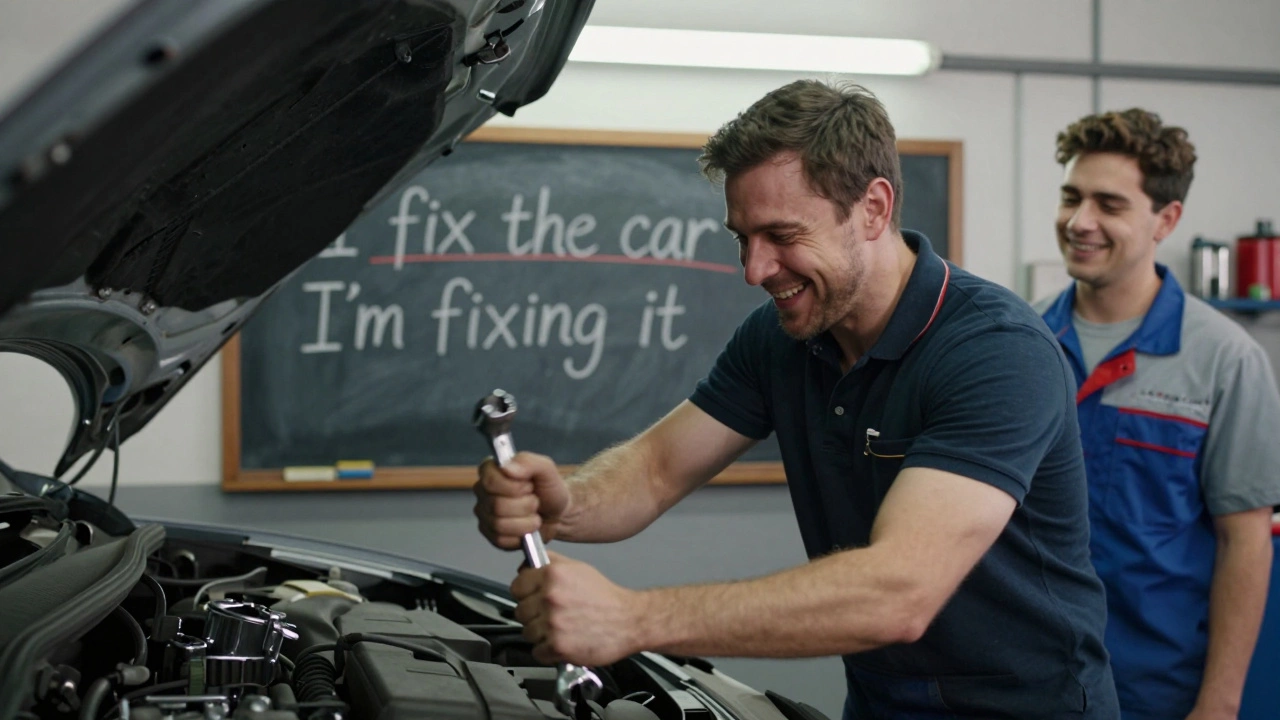
One man in Adelaide, a mechanic, started saying "I fix the car" instead of "I’m fixing the car." His coworker corrected him gently: "You’re fixing it now. You fixed it yesterday." He didn’t feel embarrassed. He felt proud. Now he leads team meetings in English.
Track progress - not perfection
You won’t wake up one day speaking perfectly. But you’ll notice small wins:
- You understood a joke on TV without subtitles.
- You asked for directions without panicking.
- You laughed at a funny comment someone made - and replied right away.
Write these down. Keep a list. Every week, add one. After three months, you’ll have 12 moments where you realized: "I’m actually speaking English." That’s your proof. That’s your momentum.
You don’t need a course. You need a routine.
Fluency isn’t about talent. It’s about repetition. It’s about showing up. Even for five minutes. Even when you’re tired. Even when you feel silly.
Here’s your simple plan:
- Listen to 15 minutes of English every day - just listen.
- Speak out loud for 5 minutes - describe your day, your thoughts, your plans.
- Use one new phrase from real life - and say it three times.
- Repeat tomorrow.
That’s it. No apps. No classes. No expensive tutors. Just you, your voice, and your daily habits.
People think learning English is hard. It’s not. It’s just different. You’re not learning grammar. You’re learning how to move your mouth. How to hear sounds. How to say what you mean - without overthinking it.
You can do this. Not because you’re smart. Not because you have time. But because you’re willing to talk - even when no one’s listening.
Can I learn to speak English without a teacher?
Yes. Thousands of people have learned to speak English without a teacher. What matters isn’t having someone correct you - it’s having enough exposure and practice. Listening daily, speaking out loud, and using real phrases from real conversations will build your speaking skills faster than any textbook. A teacher helps, but it’s not required.
How long does it take to speak English fluently?
There’s no fixed timeline. But most people notice real progress in 3 to 6 months if they practice daily. Fluency doesn’t mean perfect grammar. It means you can hold a conversation without stopping to think. If you spend 20 minutes a day listening and speaking, you’ll start noticing changes within weeks. After six months, you’ll likely understand most everyday conversations.
What if I’m shy and afraid to speak?
Start by speaking to yourself. Talk to your pet. Talk to your mirror. Record your voice and play it back. Then try one low-pressure conversation - like chatting with a native speaker on Tandem or commenting on a YouTube video. Most people are kind and patient. You don’t need to be perfect. You just need to begin. Every expert speaker was once nervous.
Should I learn grammar first?
No. Learning grammar rules before speaking is like learning how a car engine works before driving. You’ll never get behind the wheel. Focus on hearing and saying real phrases first. You’ll pick up grammar naturally through repetition. When you hear "I’ve been working" enough times, you’ll start using it - even if you don’t know what "present perfect" means.
What if I don’t have anyone to practice with?
You don’t need a person. You need a routine. Use speech mirrors like Speechling. Watch videos and repeat lines. Talk to yourself while doing chores. Join free language exchange apps like Tandem or HelloTalk - you’ll find partners who want to learn your language. You’re not alone. There are millions of people learning English the same way.

Dhruv Ainsley
I am an education specialist with a focus on international educational systems, particularly in India. I enjoy exploring how educational practices can be improved to foster better learning environments. Writing about such topics allows me to share insights and encourage meaningful discussions. My work seeks to inspire educational reforms that prioritize inclusive and quality learning experiences.