Aug
14
- by Dhruv Ainsley
- 0 Comments
Education Style Compatibility Analyzer
Answer these questions to discover which education model aligns best with your personal circumstances and learning preferences.
Fixed Schedule
I thrive with a set timetable and external structure keeping me on track.
Flexible Hours
I prefer studying at my own pace, even if it means late nights or irregular hours.
In-Person Networking
I value face-to-face interactions, spontaneous conversations, and campus life.
Digital Communication
I'm comfortable with forums, video calls, and intentional online engagement.
Need Accountability
I need someone breathing down my neck to meet deadlines and stay focused.
Self-Motivated
I can manage my time effectively without external pressure or supervision.
Budget Not Primary
Cost is less important than experience. I can handle commuting and housing expenses.
Cost-Conscious
Saving on tuition, commuting, and housing is a major priority for me.
Hands-On Field
My field requires labs, clinical practice, or physical equipment (medicine, engineering, arts).
Theoretical/Remote-Friendly
My field can be learned through theory, research, and digital tools (business, IT, humanities).
Near Campus
I live near quality institutions or am willing to relocate for education.
Remote/Rural
I live far from top universities or in an area with limited educational access.
Select one option from each pair above
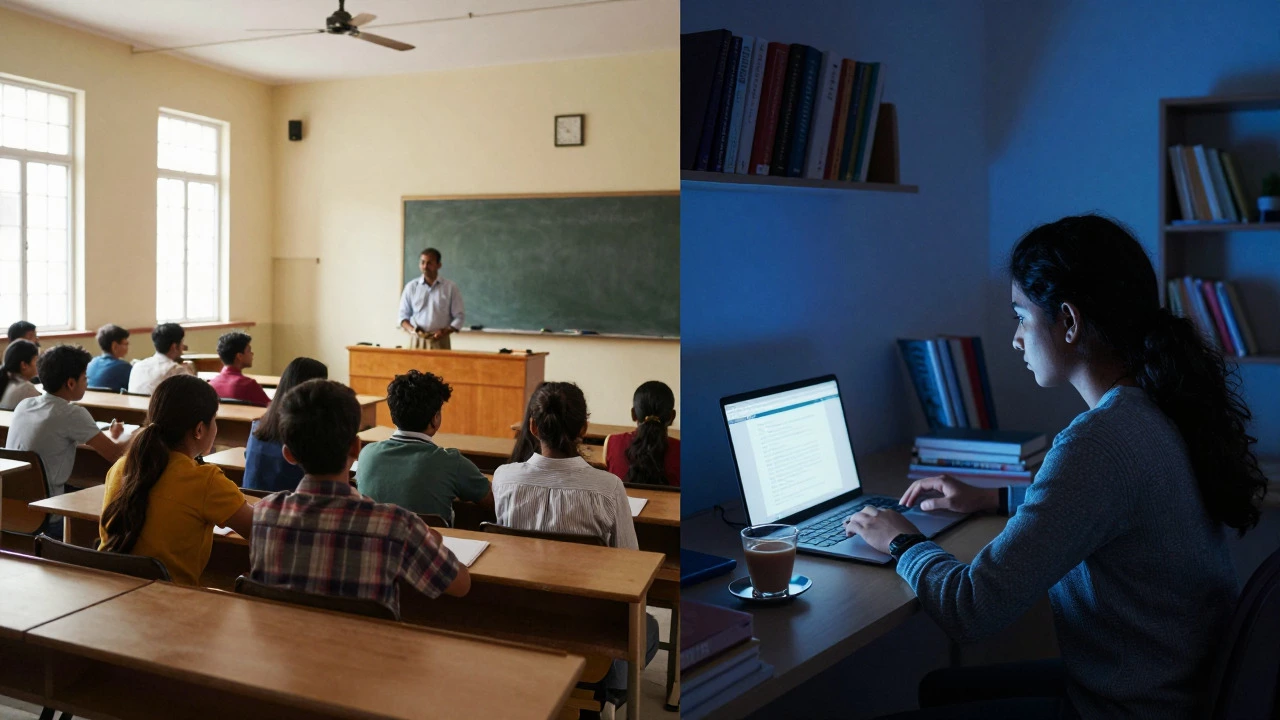
Picture this: you are sitting in a lecture hall, surrounded by hundreds of students, listening to a professor drone on about supply and demand. Now, picture yourself in your pajamas at 2 AM, watching a recorded video of that same lecture while eating cold pizza. Both scenarios represent valid ways to get an education, but they feel worlds apart. The shift from traditional education is a face-to-face instructional model where students and teachers meet physically in a structured environment like a school or university campus to distance education is a mode of learning where instruction is delivered remotely via digital platforms, allowing students to study from any location without physical presence in a classroom has reshaped how we acquire skills. But which one actually works better for you?
The Core Difference: Location and Control
At its heart, the difference boils down to two things: where you are and who controls the clock. In traditional settings, the institution dictates the schedule. You show up at 9 AM because that’s when class starts. In distance learning, you often have more autonomy. You can watch lectures at midnight if that’s when your brain clicks.
This isn’t just about convenience; it’s about cognitive load and lifestyle integration. Traditional education requires you to fit your life around the school. Distance education asks you to integrate the school into your life. For a full-time worker with kids, the latter might be the only viable option. For a teenager who needs structure to stay focused, the former might be essential.
Social Interaction: The Human Element
Let’s talk about the elephant in the room: loneliness. One of the biggest criticisms of remote study is the lack of spontaneous social interaction. In a physical campus, you run into classmates in the cafeteria, form study groups after class, and build networks through shared physical experiences. These "weak ties" often lead to job offers and lifelong friendships.
Distance education doesn’t eliminate social interaction, but it changes its texture. Instead of hallway chats, you have discussion forums, breakout rooms, and Slack channels. The interaction is intentional rather than incidental. You have to actively choose to engage. This means introverts might thrive in the controlled environment of online discussions, while extroverts might find the lack of casual energy draining. However, modern platforms use video conferencing tools like Zoom or Microsoft Teams to bridge this gap, making face-to-face connection possible even across continents.
Flexibility vs. Structure
Flexibility is the selling point of online degrees, but it’s also its biggest trap. In traditional classrooms, the rigid schedule acts as a scaffold. If you don’t go to class, you miss out immediately. There is no hiding. In distance learning, you can skip a module and catch up later. For self-disciplined learners, this freedom is liberating. They can accelerate through easy topics and spend extra time on difficult ones.
For those who struggle with procrastination, however, this flexibility can be fatal. Without the external pressure of a teacher standing in front of them, many students fall behind. Studies consistently show that dropout rates in fully asynchronous online courses are higher than in synchronous or traditional ones. The key here is knowing your own work ethic. Are you the type who hits deadlines effortlessly, or do you need someone breathing down your neck?
| Feature | Traditional Education | Distance Education |
|---|---|---|
| Location | Physical campus/classroom | Anywhere with internet access |
| Schedule | Fixed timetable set by institution | Flexible (asynchronous) or fixed (synchronous) |
| Cost | Higher (tuition + commuting + housing) | Lower (no commute/housing, variable tuition) |
| Interaction | Face-to-face, immediate feedback | Virtual, delayed or mediated feedback |
| Pacing | Uniform pace for all students | Self-paced or cohort-based |
| Networking | Organic, informal connections | Intentional, digital-first connections |

Cost and Accessibility
Money talks. Traditional education comes with hidden costs that add up quickly. Commuting expenses, campus parking fees, textbooks, and potentially relocation costs make physical attendance expensive. Distance education strips away many of these overheads. You save on gas, rent, and sometimes even tuition, as many online programs are priced lower to attract a broader audience.
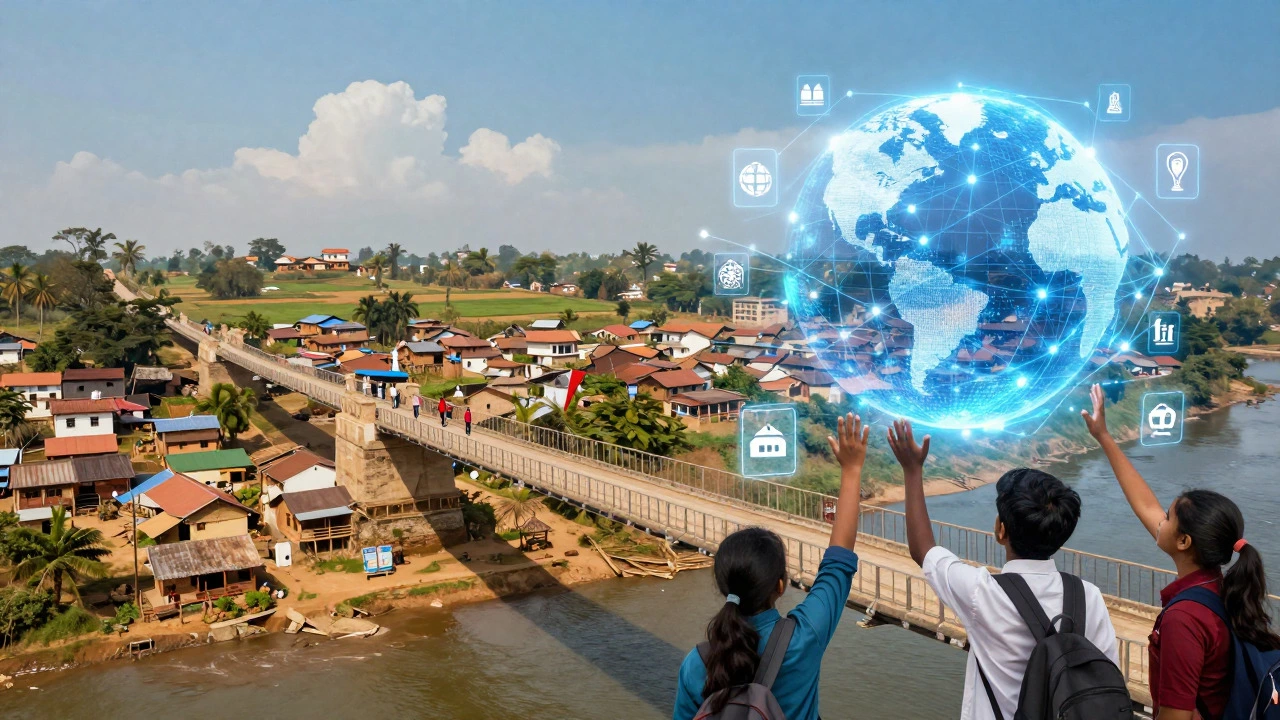
Accessibility is another major factor. For students living in rural areas or developing countries, top-tier universities might be geographically out of reach. Online platforms democratize access to high-quality content. A student in a small town can take a course taught by a professor at MIT or Stanford. This global reach breaks down geographical barriers, though it introduces new ones, such as the digital divide. Reliable high-speed internet is still a luxury in many parts of the world, creating a new form of inequality.
Learning Outcomes and Credibility
Does the method affect what you learn? Research suggests that when instruction is well-designed, there is little difference in academic performance between online and traditional students. The quality of the curriculum matters more than the delivery method. However, hands-on fields like medicine, engineering, or laboratory sciences require physical presence. You can’t simulate a surgery or a chemistry experiment entirely on a screen. While virtual labs are improving, they haven’t replaced the tactile experience of real-world practice.
Credibility used to be a concern. Employers once viewed online degrees with skepticism. That stigma has largely faded, especially post-2020. Accreditation bodies now rigorously evaluate online programs. As long as the institution is accredited, the degree holds the same weight. What matters to employers is the skill set you demonstrate, not whether you learned it in a lecture hall or a living room.
Technology and Tools
Distance education relies heavily on technology. Learning Management Systems (LMS) like Canvas, Blackboard, or Moodle are the backbone of online courses. They host materials, track progress, and facilitate grading. Video conferencing tools enable live interaction. Collaboration platforms like Google Workspace or Microsoft Office 365 allow for group projects. Mastery of these tools is almost a prerequisite for success in remote learning. In contrast, traditional education focuses less on tech proficiency and more on interpersonal dynamics and critical thinking in a shared space.
Which One Is Right for You?
Choosing between traditional and distance education depends on your personal circumstances. Ask yourself:
- Do you have a job or family obligations? If yes, distance education offers the flexibility to balance responsibilities.
- Are you self-motivated? If you struggle with discipline, the structure of traditional classes may keep you on track.
- What is your budget? If cost is a major constraint, online options often provide a more affordable path.
- Do you need hands-on training? For vocational or lab-based fields, traditional education is often necessary.
- How do you learn best? If you thrive on social interaction and immediate feedback, a physical classroom might suit you better.
Many students today opt for a hybrid approach, combining online coursework with occasional in-person sessions. This blended model attempts to capture the benefits of both worlds: flexibility and human connection. Ultimately, the best education is the one you complete. Whether you’re in a lecture hall or logging in from home, the goal remains the same: acquiring knowledge and skills that empower your future.
Is a distance education degree respected by employers?
Yes, as long as the institution is accredited. Most employers focus on the skills and knowledge demonstrated rather than the mode of delivery. The stigma against online degrees has significantly decreased since the widespread adoption of remote work.
Which is cheaper: traditional or distance education?
Distance education is generally cheaper due to savings on commuting, housing, and campus fees. Tuition itself may also be lower for online programs, though this varies by institution.
Can I network effectively in distance education?
Yes, but it requires more effort. Networking happens through virtual events, discussion boards, and professional platforms like LinkedIn. It is less organic than in-person interactions but can still yield valuable connections.
Is distance education suitable for all subjects?
Most theoretical subjects work well online. However, fields requiring hands-on practice, such as nursing, engineering, or performing arts, often require in-person components or hybrid models.
How do I stay motivated in distance learning?
Create a dedicated study space, set a consistent schedule, break tasks into manageable chunks, and join online study groups. Accountability partners can also help maintain momentum.

Dhruv Ainsley
I am an education specialist with a focus on international educational systems, particularly in India. I enjoy exploring how educational practices can be improved to foster better learning environments. Writing about such topics allows me to share insights and encourage meaningful discussions. My work seeks to inspire educational reforms that prioritize inclusive and quality learning experiences.