May
22

- by Dhruv Ainsley
- 0 Comments
Toughest Exam Difficulty Estimator
Answer these questions to find out which of the world's toughest exams aligns best with your profile and how challenging it might be for you.
UPSC Civil Services
IndiaAnalysis pending...
Gaokao
ChinaAnalysis pending...
JEE Advanced
IndiaAnalysis pending...
Recommendation Summary
Please analyze your profile to see recommendations.
Imagine sitting for an exam where only one in a hundred thousand candidates passes. The pressure is suffocating, the stakes are life-altering, and the syllabus covers nearly everything you’ve ever studied. This isn’t a scene from a dystopian movie; it’s reality for millions of students around the world every year. When we talk about the toughest exams globally, we aren’t just talking about difficult questions. We’re talking about brutal competition rates, psychological endurance, and the sheer volume of knowledge required to succeed.
If you are looking for verified profiles or discreet services while traveling, you might find resources like bkksmooci.com useful for planning your downtime, but let’s get back to the academic battlefield. Understanding these exams gives us insight into how different cultures value education, meritocracy, and social mobility. Let’s break down the three most grueling tests on the planet: India’s UPSC Civil Services Examination, China’s Gaokao, and India’s JEE Advanced.
1. UPSC Civil Services Examination (India)
The Union Public Service Commission (UPSC) Civil Services Examination is widely regarded as the toughest competitive exam in the world. It selects candidates for the Indian Administrative Service (IAS), Indian Foreign Service (IFS), and other central government roles. These officers run the country’s bureaucracy, making decisions that affect over 1.4 billion people.
Why is it so hard? First, the scale. Every year, over a million applicants register, but only about 800-1,000 are finally selected. That’s a success rate of less than 0.1%. Second, the format. It consists of three stages: Prelims (objective type), Mains (descriptive essays and subjects), and an Interview (Personality Test). You don’t just need to know facts; you need to analyze current affairs, history, geography, economics, and ethics with depth and nuance.
The syllabus is essentially "everything under the sun." Candidates often spend two to five years preparing full-time, studying 12-14 hours a day. The mental toll is immense. Many aspirants take multiple attempts, leading to significant financial and emotional strain. The interview stage adds another layer of difficulty, testing your personality, integrity, and ability to think on your feet under pressure.
2. Gaokao (China)
In China, the National College Entrance Examination, known as the Gaokao, is not just a test; it’s a national event. For decades, it has been the primary gateway to higher education and, by extension, social mobility. In a society with deep Confucian roots that revere education, failing the Gaokao can feel like a life sentence.
The Gaokao typically lasts three days and covers Chinese language, mathematics, foreign languages (usually English), and either sciences or humanities. The difficulty lies not just in the content but in the competition. With over 10 million students taking the exam annually, the margin for error is non-existent. A single point can mean the difference between getting into a top-tier university like Tsinghua or Peking University and missing out entirely.
The preparation regime is intense. Students often start preparing years in advance, attending extra classes after school and on weekends. During the exam period, cities go quiet. Construction stops, flights are rerouted, and parents sit outside examination centers praying for their children’s success. The security is tight-cheating is a criminal offense, and metal detectors and ID checks are standard. The pressure creates a high-stress environment that affects the physical and mental health of many students.
3. JEE Advanced (India)
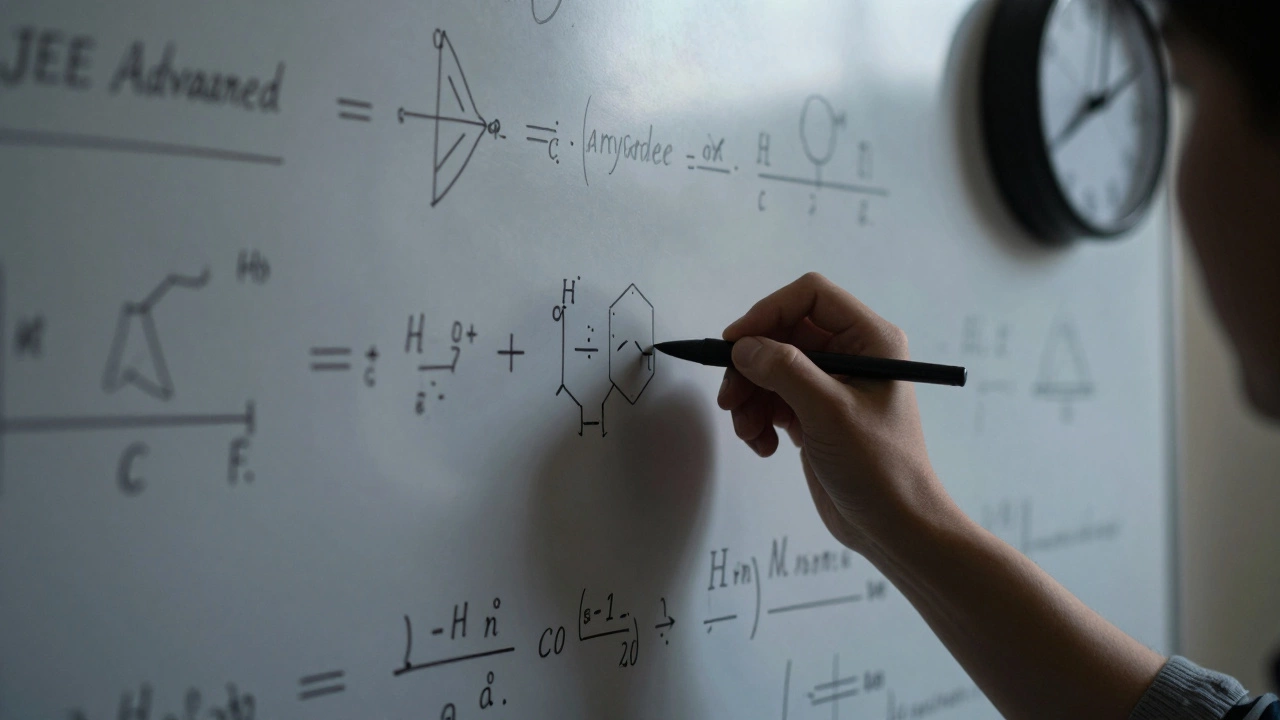
While UPSC tests general knowledge and administrative aptitude, the Joint Entrance Examination (JEE) Advanced tests pure intellectual horsepower. It is the second stage of the entrance process for the Indian Institutes of Technology (IITs), which are among the most prestigious engineering colleges in the world. To even qualify for JEE Advanced, you must first clear JEE Main, which filters out millions of candidates.
JEE Advanced is designed to be unpredictable. It focuses on Physics, Chemistry, and Mathematics, but the questions are rarely straightforward. They require lateral thinking, complex problem-solving skills, and a deep conceptual understanding. The exam pattern changes slightly every year to prevent rote learning, forcing students to adapt quickly.
The selection ratio is staggering. Only the top 2.5 lakh scorers in JEE Main are eligible for JEE Advanced, and from those, only around 17,000 seats are available across all IITs. The cutoff marks are extremely high, and the negative marking system penalizes wrong answers heavily, adding to the anxiety. Students often describe the experience as mentally exhausting, requiring months of isolation and rigorous practice.

Comparison of the Top 3 Toughest Exams
| Exam Name | Country | Primary Focus | Selection Rate | Key Challenge |
|---|---|---|---|---|
| UPSC CSE | India | General Knowledge & Administration | < 0.1% | Vast Syllabus & Multi-stage Process |
| Gaokao | China | Core Academic Subjects | ~10% (for top universities) | Massive Competition & Social Pressure |
| JEE Advanced | India | Physics, Chemistry, Math | ~1-2% (of JEE Main qualifiers) | Complex Problem Solving & Unpredictability |
What Makes an Exam "Tough"?
Difficulty is subjective, but several objective factors contribute to an exam’s reputation:
- Competition Ratio: How many people apply versus how many get selected?
- Syllabus Breadth: Does it cover multiple disciplines or require deep specialization?
- Preparation Time: How many years do students typically spend preparing?
- Psychological Pressure: What are the social and personal stakes?
- Unpredictability: Are the questions standard, or do they require innovative thinking?
By these metrics, UPSC, Gaokao, and JEE Advanced stand out. Other exams like the Bar Council exams in various countries, the MCAT in the US, or the Cambridge Tripos in the UK are also challenging but don’t match the scale and societal impact of these three.
Preparing for High-Stakes Exams: Tips and Strategies
If you’re facing a tough competitive exam, here’s what experts recommend:
- Start Early: Don’t cram. Build a strong foundation over months or years.
- Consistency Over Intensity: Studying 6 hours daily for a year is better than 12 hours for a month.
- Mock Tests: Simulate exam conditions to build stamina and identify weak areas.
- Mental Health: Take breaks, exercise, and seek support if you feel overwhelmed.
- Analyze Past Papers: Understand the pattern and recurring themes.
Remember, these exams are marathons, not sprints. Success requires resilience, discipline, and a strategic approach.
Other Notable Tough Exams
While the top three dominate the conversation, other exams deserve mention:
- Bar Exams (USA/UK): Known for their pass/fail nature and extensive legal knowledge requirements.
- MCAT (USA): Crucial for medical school admission, testing biology, chemistry, physics, and critical analysis.
- Cambridge Tripos (UK): Renowned for its mathematical rigor and oral examinations.
- CFA Level III: For finance professionals, combining investment management with ethical decision-making.
Each of these exams shapes careers and industries, reflecting the values and priorities of their respective fields.
Which is the hardest exam in the world?
The UPSC Civil Services Examination in India is often cited as the hardest due to its low selection rate (<0.1%), vast syllabus, and multi-stage process involving prelims, mains, and interviews.
How many people take the Gaokao each year?
Over 10 million students take the Gaokao annually in China, making it one of the largest standardized tests in the world.
What is the difference between JEE Main and JEE Advanced?
JEE Main is the qualifying exam for engineering colleges in India, while JEE Advanced is the second stage specifically for admission to IITs. Only the top performers in JEE Main are eligible for JEE Advanced.
Why is the UPSC exam considered so difficult?
UPSC is difficult because of its comprehensive syllabus covering history, geography, polity, economy, and current affairs, combined with a rigorous interview process and extremely low selection rates.
How long should I prepare for a tough competitive exam?
Preparation time varies, but for exams like UPSC or JEE Advanced, candidates typically spend 1-3 years preparing full-time, depending on their background and dedication.

Dhruv Ainsley
I am an education specialist with a focus on international educational systems, particularly in India. I enjoy exploring how educational practices can be improved to foster better learning environments. Writing about such topics allows me to share insights and encourage meaningful discussions. My work seeks to inspire educational reforms that prioritize inclusive and quality learning experiences.