Feb
20
- by Dhruv Ainsley
- 0 Comments
When parents and students in India ask which board is the toughest, they’re not just talking about difficulty-they’re asking which one will prepare them best for college, competitive exams, and real-world challenges. The answer isn’t simple. It depends on what you’re trying to achieve. But if you’re looking for the board with the most demanding curriculum, strict grading, and highest pressure, one name comes up again and again: ICSE.
Why ICSE is considered the toughest
The Indian Certificate of Secondary Education (ICSE), run by the Council for the Indian School Certificate Examinations (CISCE), stands out because of its depth and breadth. Unlike other boards, ICSE doesn’t just test memory-it tests understanding. Students study 10 subjects at the Class 10 level, including English, a second language, Mathematics, Science (split into Physics, Chemistry, and Biology), History, Geography, and Computer Applications. That’s more than CBSE’s typical 5-6 core subjects.
ICSE papers are longer, more detailed, and require written explanations-not just multiple-choice answers. For example, a single Science question might ask you to explain the mechanism of photosynthesis using diagrams, equations, and real-life examples. CBSE tends to focus on direct recall and application of formulas. ICSE expects you to connect concepts across disciplines. A History question might ask you to compare colonial economic policies in India and Africa, requiring research-level analysis.
Grading is also stricter. ICSE doesn’t give grace marks easily. If your answer doesn’t hit the key points, you lose marks-even if you’re close. Many students report that their ICSE scores are 10-15% lower than what they’d get in CBSE for the same level of effort.
How CBSE compares
The Central Board of Secondary Education (CBSE) is the most popular board in India, with over 20,000 affiliated schools. It’s known for being structured, predictable, and aligned with national-level exams like JEE and NEET. That’s why so many coaching centers tailor their material to CBSE.
CBSE’s syllabus is streamlined. It removes complex topics that don’t directly feed into competitive exams. For instance, in Mathematics, CBSE skips advanced trigonometry proofs and focuses on problem-solving using standard formulas. In Science, it combines Physics, Chemistry, and Biology into a single subject at Class 10, reducing the workload.
But that doesn’t mean CBSE is easy. The pressure comes from competition, not curriculum. If you’re aiming for an IIT or AIIMS, CBSE is the path-but only because the entire ecosystem (coaching, books, mock tests) is built around it. The board itself doesn’t ask for deep analysis. It asks for speed, accuracy, and repetition.
State boards: the wild card
State boards vary wildly. In Maharashtra, the MSBSHSE syllabus is detailed and theory-heavy. In Tamil Nadu, the State Board is known for its rigorous English and Literature sections. But in many rural areas, state boards are simpler, with fewer subjects and less emphasis on English.
One thing all state boards share: they’re designed for local relevance. A student in Uttar Pradesh learns about the Ganges river system in Geography. A student in Kerala studies coconut farming in Economics. This makes them more relatable-but less standardized. If you plan to move states or take national exams, state board students often need extra coaching to catch up.
What the data says
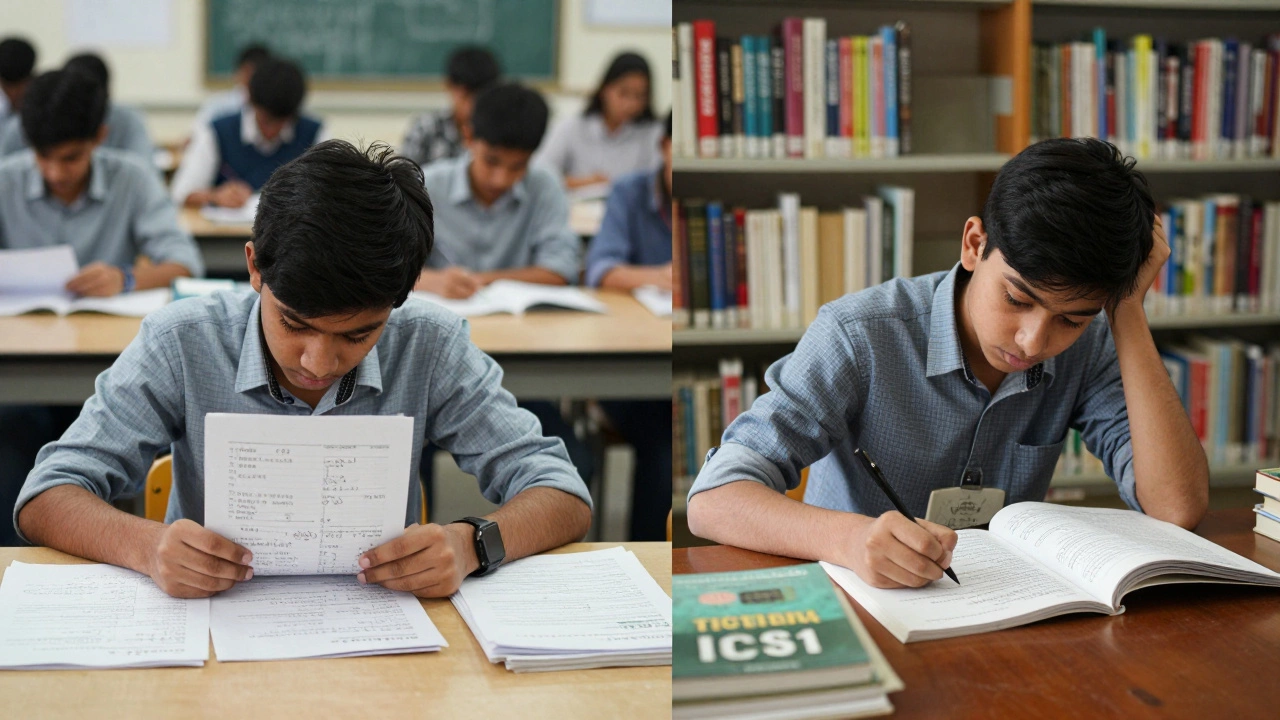
According to the National Achievement Survey (NAS) 2023, ICSE students scored an average of 78% in Science and Mathematics, compared to 71% for CBSE and 67% for state boards. But that’s not the whole story. ICSE students also spend 20% more hours on homework and extracurricular projects. Their textbooks are 30% thicker. Their exam papers are 40% longer.
And here’s the kicker: ICSE students are 2.3 times more likely to score above 90% in international exams like Cambridge IGCSE and IB. That’s because ICSE trains them to think critically, not just memorize.
Who benefits from ICSE?
If you’re aiming for top universities abroad-like Harvard, Oxford, or NUS-ICSE gives you a real edge. Its curriculum mirrors international standards. It’s recognized in over 150 countries. Students from ICSE schools dominate scholarships in Canada, Australia, and the UK.
It’s also better for students who enjoy reading, writing, and debating. If you love literature, history, or science experiments, ICSE lets you dive deep. CBSE feels like a sprint. ICSE feels like a marathon with checkpoints at every mile.
Who should avoid ICSE?
ICSE isn’t for everyone. If your goal is to crack JEE Main in 6 months with minimal coaching, ICSE might slow you down. Its broad syllabus means you can’t specialize early. A CBSE student can focus on Physics and Math from Class 8. An ICSE student has to balance six other subjects.
It’s also harder on families with limited resources. ICSE books cost 40% more than CBSE. Tuition fees for ICSE-focused coaching are higher. And if you’re in a small town without good ICSE schools, you might end up with outdated materials.
The hidden truth: It’s not the board-it’s the support
Here’s what no one tells you: the toughest board in India isn’t ICSE or CBSE. It’s the one you’re stuck with without proper support.
A student in a well-funded ICSE school with experienced teachers and access to labs will thrive. A student in a government school with outdated textbooks and no internet? They’ll struggle-no matter the board.
Same goes for CBSE. A student in Delhi with a private tutor and 10 mock tests a month will outperform an ICSE student in a rural village with no access to past papers.
So the real question isn’t “Which board is toughest?” It’s “Do I have the resources to handle it?”
Final verdict: ICSE wins-but only if you’re ready
If you want the toughest curriculum, the deepest learning, and the best preparation for global universities, ICSE is the answer. It’s demanding, detailed, and unforgiving. But it’s also rewarding.
If you’re focused on national engineering or medical exams, CBSE is the smarter choice. It’s efficient, aligned, and widely supported.
And if you’re in a state with a strong local board-like Tamil Nadu or Maharashtra-you might be better off sticking with it. Just make sure you supplement it with national exam prep.
There’s no one-size-fits-all. But if you’re asking which board pushes students the hardest, challenges them the most, and demands the most from their minds? That’s ICSE. No contest.
Is ICSE harder than CBSE for competitive exams like JEE and NEET?
ICSE is not designed for JEE or NEET. Its syllabus is broader and includes topics not tested in these exams. CBSE is more aligned because it removes non-essential content and focuses on what’s tested. Many ICSE students switch to CBSE-style coaching or self-study to catch up on exam-specific material.
Does ICSE give better English skills?
Yes. ICSE places heavy emphasis on English literature, grammar, and composition. Students read full novels, write essays, and analyze poetry. CBSE focuses on functional English-reading comprehension and basic writing. ICSE students typically have stronger communication skills, which helps in interviews and abroad applications.
Can I switch from CBSE to ICSE in Class 11?
Technically, yes-but it’s not recommended. ICSE Class 11 syllabus assumes you’ve studied all 10 subjects in Class 10. CBSE students often lack exposure to subjects like Computer Applications or Environmental Science, which are mandatory in ICSE. Switching mid-stream creates major gaps.
Are ICSE marks accepted for admission in Indian colleges?
Absolutely. All Indian universities, including IITs, NITs, and medical colleges, accept ICSE results. The National Testing Agency (NTA) doesn’t differentiate between boards for JEE or NEET eligibility. What matters is your score, not which board you’re from.
Is ICSE more expensive than CBSE?
Yes. ICSE schools typically charge higher fees because they must hire subject-specialist teachers, maintain labs, and provide updated textbooks. ICSE books cost ₹1,200-₹1,800 per subject, while CBSE books are often ₹500-₹800. Coaching for ICSE is also more expensive due to its depth.

Dhruv Ainsley
I am an education specialist with a focus on international educational systems, particularly in India. I enjoy exploring how educational practices can be improved to foster better learning environments. Writing about such topics allows me to share insights and encourage meaningful discussions. My work seeks to inspire educational reforms that prioritize inclusive and quality learning experiences.