Mar
20

- by Dhruv Ainsley
- 0 Comments
Test Selection Guide
Which Test Do You Need for U.S. University Admissions?
Answer a few questions to determine the correct standardized test for your application.
If you're planning to study in the USA, you're probably overwhelmed by the number of tests you might need to take. Which one actually matters? Should you take the SAT, ACT, GRE, TOEFL, or IELTS? There’s no single answer - it depends on what kind of program you're applying to, where you're from, and what your goals are. Let’s cut through the noise and show you exactly which test you need, when, and why.
Undergraduate Programs: SAT or ACT?
If you're applying for a bachelor’s degree in the USA, you’ll likely need to take either the SAT a standardized test used for undergraduate admissions in the United States, administered by the College Board or the ACT a standardized college admissions test that includes a science section and is administered by ACT, Inc.. Both are accepted by every four-year college in the country, so it’s not about which one is "better" - it’s about which one suits your strengths.
The SAT focuses more on critical reading and math, with an emphasis on vocabulary and problem-solving. The math section includes more algebra and data analysis. The ACT, on the other hand, has a dedicated science section (not about memorizing facts, but about interpreting graphs and experiments) and includes trigonometry. It also moves faster - you have less time per question.
Here’s the real difference: if you’re strong in science and work quickly under pressure, the ACT might feel more natural. If you’re better at reasoning through complex reading passages and don’t mind slower pacing, the SAT could be a better fit. Most students take both tests once to see which score is higher. Many colleges don’t care which one you take - they just want to see strong scores.
Graduate Programs: GRE, GMAT, or MCAT?
If you’re heading to grad school, the test you need changes completely. For most master’s programs outside of business or medicine, the GRE Graduate Record Examination, a standardized test required for admission to many graduate schools in the United States and other countries is the go-to. It’s used for programs in engineering, psychology, biology, and even some humanities degrees.
The GRE has three sections: Verbal Reasoning, Quantitative Reasoning, and Analytical Writing. The Verbal section is known for its tough vocabulary - words like "ubiquitous," "obfuscate," and "serendipity" show up often. The Quant section is less advanced than the SAT or ACT math, but still requires solid algebra and data interpretation skills.
But here’s the catch: if you’re applying for an MBA, you’ll probably need the GMAT Graduate Management Admission Test, a standardized test used for admission to graduate business programs. The GMAT is more focused on analytical reasoning and data sufficiency - think logic puzzles disguised as math problems. Business schools love it because it predicts how well you’ll handle real-world business decisions.
For medical school? The MCAT Medical College Admission Test, a standardized exam for prospective medical students in the United States and Canada is non-negotiable. It’s long, dense, and covers biology, chemistry, physics, psychology, and critical analysis. You’re looking at over seven hours of testing. No shortcuts here.
English Proficiency: TOEFL or IELTS?
If English isn’t your first language, you’ll need to prove your language skills. That’s where TOEFL Test of English as a Foreign Language, a standardized test measuring English language proficiency for non-native speakers applying to universities in English-speaking countries and IELTS International English Language Testing System, a standardized test of English language proficiency for non-native speakers seeking admission to universities in English-speaking countries come in.
TOEFL is more common in the USA. Over 90% of American universities accept it. It’s entirely computer-based, with speaking done into a microphone and essays typed. The questions are academic - think listening to a lecture on astrophysics and answering multiple-choice questions.
IELTS has two versions: Academic (for university) and General Training (for work or immigration). The Academic version is what you need. It includes a face-to-face speaking interview with an examiner - some people find this less stressful than talking to a computer. IELTS also uses British spelling and has slightly more varied accents in the listening section.
Bottom line: if you’re applying to U.S. schools, TOEFL is the safer bet. But if you’re also considering the UK, Canada, or Australia, IELTS gives you more flexibility. Many students take both to maximize their chances.

What About the LSAT?
If law school is your goal, you need the LSAT Law School Admission Test, a standardized test required for admission to most law schools in the United States, Canada, and some other countries. It’s not about what you know - it’s about how you think. The LSAT tests logical reasoning, reading comprehension, and analytical reasoning (logic games). There’s no math, no history, no science. Just pure logic.
Law schools don’t care about your GPA as much as they care about your LSAT score. A high LSAT can make up for a lower GPA. It’s the single biggest factor in admissions. If you’re serious about law school, you need to prep for this test like it’s a sport - daily practice, timed drills, and pattern recognition.
Which Test Should You Take? A Quick Decision Guide
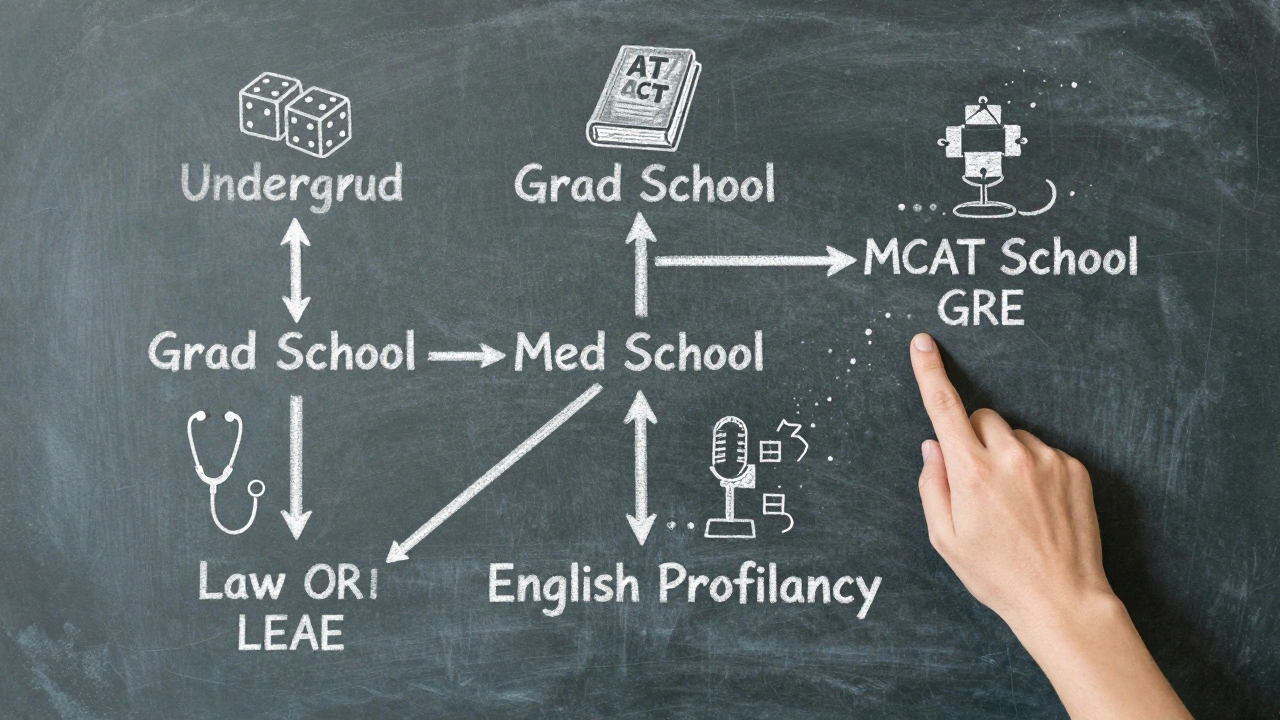
Let’s make this simple. Here’s what you need based on your situation:
- High school student applying to U.S. undergrad? Take the SAT or ACT. Try both. Submit the higher score.
- Applying for a master’s in engineering, psychology, or social sciences? Take the GRE. Most programs require it.
- Applying for an MBA? Take the GMAT. It’s still the gold standard for business schools.
- Going to medical school? You must take the MCAT. Start early - it’s the longest and hardest of all.
- Law school? The LSAT is your only option. Don’t skip it.
- Non-native English speaker? Take the TOEFL for U.S. schools. Take IELTS if you’re also looking at other countries.
Common Mistakes to Avoid
People make the same mistakes over and over:
- Thinking they can skip the English test because they "spoke English in school." U.S. universities require proof - even if you studied in an English-speaking country.
- Waiting until the last minute to take the test. Scores take weeks to arrive. Deadlines don’t wait.
- Ignoring score requirements. Some programs have minimums - like a 100 on TOEFL or 310 on GRE. If you’re below, your application might not even be reviewed.
- Assuming one test is "easier." The easiest test is the one that matches your skills. Practice both if you can.
How to Prepare
Free resources are everywhere. The College Board offers official SAT practice on Khan Academy. ETS (the makers of TOEFL and GRE) have free practice tests on their websites. For the LSAT, the Law School Admission Council has past exams available. For the GMAT, use the official GMATPrep software.
Don’t buy expensive prep courses unless you need structure. Many students score just as well using free materials and disciplined self-study. Set a goal. Take a diagnostic test. Work on weak areas. Take another test. Repeat.
Final Thoughts
There’s no "best" test for everyone. The best test is the one that aligns with your goals and plays to your strengths. Don’t try to take every test. Pick the one that matters for your program. Study smart. Don’t cram. And remember - your test score is just one part of your application. Your essays, recommendations, and extracurriculars matter too.
If you’re still unsure, check the admissions page of every school you’re interested in. They list exactly which tests they require and what scores they expect. No guesswork needed.
Is the SAT required for all U.S. colleges?
No. Many colleges have gone test-optional, meaning you can apply without submitting SAT or ACT scores. But top-tier schools still value high scores, and some scholarships require them. Even if a school is test-optional, submitting a strong score can improve your chances.
Can I take the TOEFL and IELTS at the same time?
Yes, but it’s usually unnecessary. Most U.S. schools accept both. Taking both only makes sense if you’re applying to schools in multiple countries (like the UK, Canada, or Australia) and want to maximize your options. For U.S.-only applications, focus on TOEFL.
Which is harder: GRE or GMAT?
It depends. The GRE has harder vocabulary and more abstract math questions. The GMAT has trickier logic problems and data sufficiency questions that are unique to it. If you’re strong in math, the GRE might feel easier. If you’re good at critical reasoning and business-style problems, the GMAT could be more natural.
Do I need to take all these tests if I’m applying to multiple programs?
No. You only need the tests required by each program. For example: if you’re applying to an engineering master’s and an MBA, you’d take the GRE for engineering and the GMAT for business. You don’t need both unless each program requires its own test. Always check the official requirements.
What if I score below the minimum requirement?
It doesn’t mean automatic rejection, but your chances drop sharply. Some schools may still consider you if you have exceptional work experience, research, or recommendations. But most programs have cutoffs for a reason - they get too many applications. Retake the test if you can. Many students improve significantly on their second attempt.
Are there any tests I don’t need to take?
Yes. For example, if you’re a native English speaker from a country like Australia, the UK, or Canada, you typically don’t need TOEFL or IELTS. Also, if you’re applying to a PhD program in the humanities, you usually don’t need the GMAT. Always verify requirements directly with the school - don’t assume.

Dhruv Ainsley
I am an education specialist with a focus on international educational systems, particularly in India. I enjoy exploring how educational practices can be improved to foster better learning environments. Writing about such topics allows me to share insights and encourage meaningful discussions. My work seeks to inspire educational reforms that prioritize inclusive and quality learning experiences.