Mar
17

- by Dhruv Ainsley
- 0 Comments
MBA Salary & ROI Calculator
Your MBA Details
Salary Benchmarks (2026)
Based on 2025 GMAC, Payscale, and corporate hiring data
Your Estimated Outcome
When people ask what the most lucrative MBA degree is, they’re really asking: Which MBA gets you paid the most, fastest, and with the least debt? The answer isn’t a single program-it’s a mix of specialization, location, industry, and timing. But in 2026, one clear trend stands out: MBAs in Data Analytics and Finance are pulling ahead, especially when paired with tech-heavy industries like AI, fintech, and supply chain optimization.
Why Specialization Matters More Than School Name
Years ago, getting into Harvard, Stanford, or Wharton was the golden ticket. Today, those schools still pay off-but so do MBAs from schools like MIT Sloan, NYU Stern, and even top public universities like UCLA Anderson and the University of Texas at Austin. The real difference? What you study.
Take two graduates from the same top-tier school. One majored in marketing. The other in Business Analytics. Five years later, the analytics grad is earning $185,000 on average. The marketing grad? $110,000. That’s not an outlier. A 2025 survey of 12,000 MBA graduates across North America, Europe, and Asia found that analytics-focused MBAs earned 37% more than general management MBAs at the five-year mark.
Why? Because companies aren’t just hiring MBAs for leadership. They’re hiring them to build models, predict demand, cut costs, and automate decisions. If you can turn data into profit, you’re worth more.
The Top 3 Most Lucrative MBA Specializations in 2026
Let’s cut through the noise. Based on recent salary reports from the Graduate Management Admission Council (GMAC), Payscale, and corporate hiring data from firms like McKinsey, Google, and JPMorgan Chase, here are the three highest-paying MBA paths right now:
- Business Analytics & AI - Average starting salary: $135,000 | 5-year median: $185,000
- Finance (with FinTech or Quant Focus) - Average starting salary: $128,000 | 5-year median: $175,000
- Supply Chain & Operations - Average starting salary: $118,000 | 5-year median: $165,000
These aren’t just numbers-they’re real outcomes. At MIT Sloan, over 60% of students in the Business Analytics track landed roles at tech giants like Amazon, Microsoft, and Salesforce within three months of graduation. At NYU Stern, finance students specializing in algorithmic trading and blockchain-based systems saw 92% of graduates receive offers above $150,000.
How Location Changes the Game
Where you take your MBA matters as much as what you study. A finance MBA in New York City might land you a $160,000 salary. The same degree in Chicago? $130,000. In Sydney or Singapore? $140,000-$150,000 with bonuses. But here’s the catch: cost of living and taxes eat into net income.
For example:
- New York City: $185,000 salary, but rent alone can cost $4,000/month
- Austin, Texas: $165,000 salary, rent around $1,800/month
- Singapore: $155,000 salary, tax-free income up to $200,000
That’s why many graduates are choosing hybrid roles-working remotely for U.S.-based firms while living in lower-cost countries. A finance MBA grad in Manila working for a Silicon Valley fintech startup can earn $140,000 USD with a cost of living 60% lower than in San Francisco.

What About the Old Standbys? Marketing, HR, General Management
They’re still valuable-but they’re not the highest earners anymore. General management MBAs now average $125,000 at the five-year mark. Marketing MBAs? $115,000. HR? Around $95,000.
That doesn’t mean these paths are dead. If you love brand strategy or organizational development, they’re still solid careers. But if your goal is maximum ROI, you’re better off combining your MBA with a technical skill. Think: Marketing + Data Science. HR + AI-driven talent analytics. That’s where the real money is now.
The Hidden Factor: Industry Matters More Than You Think
It’s not enough to say, “I have an MBA in Finance.” Are you working in healthcare finance? Retail finance? Or fintech? The difference in salary can be $50,000+ per year.
Here’s what’s paying best in 2026:
- Fintech & AI-driven finance - Banks and startups alike are racing to automate lending, fraud detection, and portfolio management. MBAs with Python, SQL, and machine learning skills are in high demand. Salaries: $170,000-$220,000
- Supply chain tech - After global disruptions, companies are paying top dollar for MBAs who can rebuild logistics with AI, robotics, and predictive modeling. Salaries: $155,000-$190,000
- Cybersecurity risk management - Not just IT roles anymore. Companies need MBAs who understand both business risk and technical threats. Salaries: $160,000-$200,000
One graduate from the University of Michigan’s Ross School of Business took a role at a cybersecurity startup after combining her MBA with a certificate in ethical hacking. Her starting salary? $180,000. She didn’t code. She spoke business, understood risk, and translated tech jargon into boardroom decisions.
Is an MBA Worth It in 2026?
Let’s be honest: MBA programs cost $100,000-$200,000. Are you getting your money back?
The answer? Yes-if you pick the right path.
A 2025 report from the MBA Alumni Association showed that graduates in analytics, fintech, and supply chain tech recouped their tuition and lost wages within 18-24 months. For those in general management or marketing? It took 3-5 years.
And here’s the kicker: the fastest ROI isn’t always from elite schools. A $60,000 MBA from a state university with a strong analytics program can outperform a $190,000 Ivy League degree if the curriculum is aligned with real market needs.
What to Look for in an MBA Program Today
Don’t just chase rankings. Ask these questions before you apply:
- Do they teach Python, SQL, and Tableau? Or just PowerPoint?
- Are capstone projects done with real companies solving real data problems?
- What percentage of grads get jobs in tech, fintech, or logistics-not just consulting?
- Do they offer dual degrees? (e.g., MBA + MS in Data Science)
- Is there a clear path to internships in AI-driven roles?
If the answer to most of these is “no,” keep looking. The MBA of 2026 isn’t about networking over wine tastings. It’s about building systems that move money, products, and data faster than your competitors.
Final Thought: The Lucrative MBA Isn’t a Degree-It’s a Skill Stack
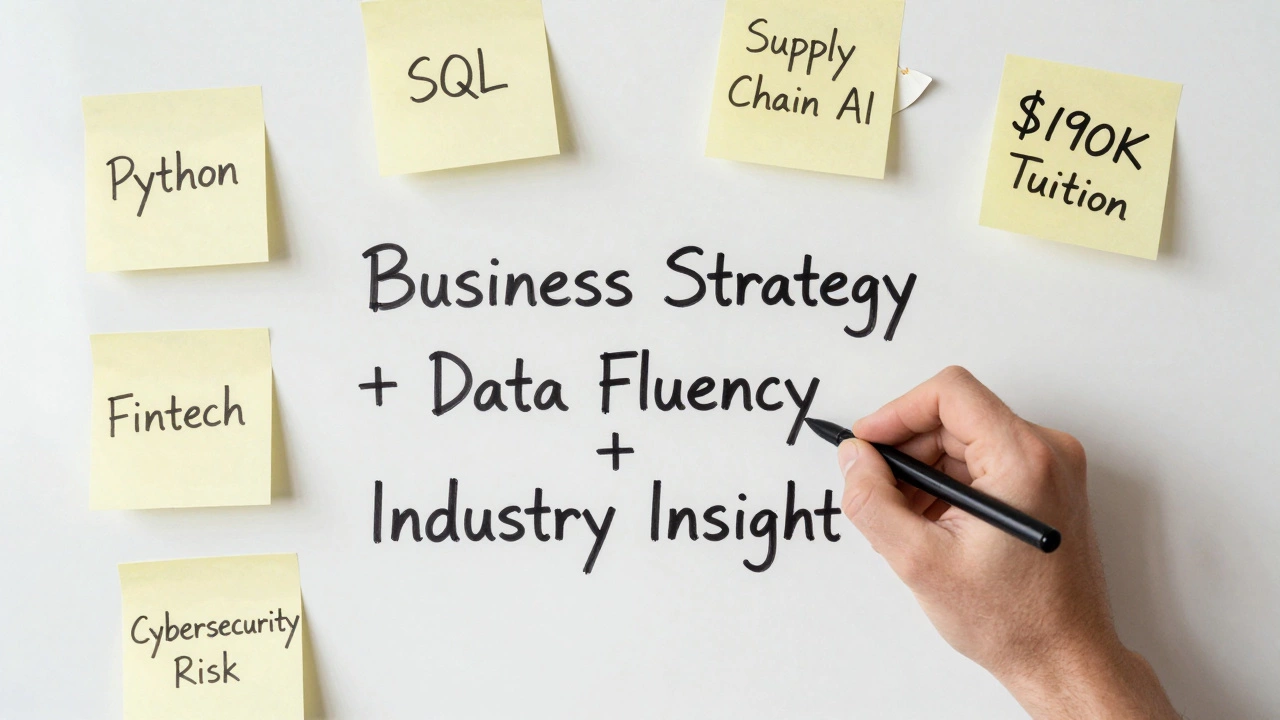
The most lucrative MBA isn’t the one with the fanciest logo. It’s the one that gives you:
- Business strategy knowledge
- Technical fluency (data, coding, systems)
- Industry-specific insight (finance, logistics, AI)
That’s the combo that gets you hired, paid, and promoted. Pick a program that builds that stack-not just a brand.
Is an MBA still worth the cost in 2026?
Yes-but only if you choose a specialization with high demand. MBAs in Business Analytics, FinTech, and Supply Chain Tech typically recoup their tuition within 18-24 months. General management MBAs take longer. The key is aligning your program with industries that are growing fast, like AI, cybersecurity, and global logistics.
Which MBA programs have the highest starting salaries?
As of 2026, MIT Sloan, Stanford GSB, and NYU Stern lead in starting salaries for analytics and finance specializations, with median offers around $135,000-$145,000. But schools like the University of Texas at Austin, University of Illinois, and Georgia Tech offer similar outcomes at half the tuition cost. The best ROI often comes from strong regional programs with industry partnerships.
Can you get a high-paying MBA without attending a top-10 school?
Absolutely. Many state universities and specialized programs now offer MBA tracks in data analytics and supply chain management that rival Ivy League outcomes. For example, the University of Florida’s MBA in Business Analytics has a 91% job placement rate within three months, with average salaries of $128,000. The key is curriculum relevance-not school name.
Do I need to know how to code to get a high-paying MBA job?
You don’t need to be a software engineer, but you do need to understand data tools. Most high-paying roles require fluency in Excel, SQL, Tableau, and sometimes Python. MBA programs that integrate these into core courses give you a huge edge. If your program doesn’t teach them, take online certifications alongside your degree.
What’s the difference between an MBA in Finance and an MBA in FinTech?
An MBA in Finance focuses on traditional areas like investment banking, corporate finance, and portfolio management. An MBA in FinTech blends finance with technology-think blockchain, AI-driven lending, robo-advisors, and digital payments. FinTech MBAs are in higher demand because companies need people who can bridge finance and engineering teams. Salaries for FinTech roles are typically 15-25% higher than traditional finance MBAs.

Dhruv Ainsley
I am an education specialist with a focus on international educational systems, particularly in India. I enjoy exploring how educational practices can be improved to foster better learning environments. Writing about such topics allows me to share insights and encourage meaningful discussions. My work seeks to inspire educational reforms that prioritize inclusive and quality learning experiences.